Friday, June 15, 2012

The "Hot Iron" League...

Today's post features an item that isn't exactly a card, but fits the vintage topic well:


This blank-backed piece of fabric was issued in 1961by a company called Chemstrand and was intended to be ironed on to a shirt, pants, jacket or other item, with the loving care that only Mom can give. It came along with the purchase of a new shirt and came in a package that had instructions for returning it in exchange for a different star.

This page about Yogi Berra has some ads and a scan of the package. I could simply gab the scans and show them here, but Mark (the guy who set up the page there) is a hobby friend and I'd rather send him some traffic.

Wednesday, June 13, 2012

Unopened Vintage Hoops

The NBA Finals kicked off last night and the Oklahoma City Thunder took the first game. In commemoration of that, here's a hoops-related item that doesn't get seen all that often:


It's an unopened pack of 1948 Bowman basketball cards. Available for five cents, it contained five cards plus a slab of bubble gum. Though not the earliest basketball cards, it was the first nationally-issued set after both World War II and the founding of the NBA. It's a fairly safe bet they didn't sell well, since Bowman never tried to make them again. In fact, fans had to wait until 1957 before Topps tried for the first time.

I need to say that this isn't my pack...I'd be way too tempted to open it.

Monday, June 11, 2012

Here Goes Nothing...

On Mondays, I usually post about a set, of a type of card, or an in-depth look at something. This post has nothing to do with that. Let me explain:

On Friday, I read this message on a hobby board I frequent...

SCP Auctions, the leading auctioneer and private seller of important sports memorabilia and cards, is seeking a motivated, organized and experienced individual to fill the full-time position of Auction Cataloguer. Primary responsibilities will include receiving, organizing and sorting cards and memorabilia for lotting, lot entry into auction program and writing lot descriptions for catalogs. This is a great opportunity to become an integral part of a small, but highly productive organization that is among the most accomplished and respected companies in an exciting sports-centric field. Compensation package, including benefits, based on experience.


Please forward your resume to (email address redacted).

I immediately sent in my resume. This looks like something where I'd be an ideal candidate. I've been in the hobby since 1978. I've been studying the history of the hobby since 1983. I wrote a hobby booklet and am threatening to write another (in fact, it should be about finished). I've been writing hobby-related stuff for over 10 years (including these magazine articles). I've attended several Nationals in that span of time as well. I've been writing this blog for more than two years on a regular basis, plus another card-related blog...and I've been on time with those posts for the entire time I've written them. Not only that, but I'm a member of several hobby-related groups. If I don't know what something is, I can find out pretty quickly. I'm also the vintage guy at Cardboard Connection, writing set-related content there.

If they need somebody who knows the hobby, I have that. If they need somebody who isn't going to get confused by the difference between a T206, an M116 and and an E95 because they all share a white border...I am that guy. If they need an organization guy...I've been sorting cards since 1978. If they need a decent communicator...I have a Bachelors' Degree in Communication and a military background as a communications specialist. The description above describes me in detail, and I am dead serious that I can fill that job more than capably.

And here's the reason I'm writing this...this hobby is big, but it's small enough that I'm hoping that some of my readers have contact with Dan Imler over at SCP, or SCP's President David Kohler...or any of SCP's other heads, and might drop them an email and let them know they don't need to search far to find the person who can fill the position they're looking to fill. I'm available to relocate if necessary (no family issues, no house to get out from under, no issues with competitors that might create problems).

I've learned over the past couple of years that stuff drops through the cracks when it comes to submitting resumes...and this time, I want to do my best to make sure mine doesn't get misplaced so easily. So, if anybody has the ability to help me reach them, I'd really appreciate it.

Friday, June 8, 2012

Cut From a Different Cloth

Today's post features a card of a player elected into the Hall of Fame last year:


While it looks like an out-of-register 1977 Topps card, it's actually made out of cloth and placed on an adhesive sticker backing. Often mislabeled as an "insert," it was actually issued in its own pack with a checklist card that was part of a puzzle that showed one of the two All-Star squads after being assembled. There were 55 stickers in the set and 18 different checklist cards.

Though the front looks the same, the back has a different design: 


If you look at the bottom left corner, you'll see two asterisks. Each card in the set is found with either one or two asterisks there due to the layout on the printing sheet. Completists will try to get all 110 cards for a "master set," but there isn't any price between the variations.

Wednesday, June 6, 2012

Another Practical Joke...

Today's card comes from the 1965 Topps set and shows a right-handed player posing as a left-handed batter. You can see that it's not a flipped negative, since his hat logo is correct:


Of course, Bob Uecker has become known as a wisecracker even among people who aren't baseball fans, thanks to a series of Miller Light commercials ("I must be in the front row") as well as a regular spot in the ABC-TV show Mr. Belvedere.

The same year this picture was taken, Uecker won his only World Series ring. He never got a chance to play in that Series, but that didn't stop him from getting noticed for his sense of humor. While shagging flies during a pre-game batting practice, Uecker noticed that a brass marching band was standing nearby. He grabbed a tuba and caught several balls with it.

Anyway, Uecker decided to pose for this card holding the bat incorrectly. As a backup catcher (and a lifetime .200 hitter), nobody noticed. However, the sly smile on his face lets on that he's up to no good.

Monday, June 4, 2012

Underappreciated Set From the 1950s...

Today, here's a tribute to one of my favorite sets from the 1950s...but one that doesn't get the attention that many do. No, it's not as aesthetically pleasing, and lacks many of the "big name" cards found in other sets, but it should be given a little hobby love.

The 1958 Topps set is one that collectors either love or hate. Some find the design bold, while others feel it's unimaginative. The cards are relatively easy to find; however, variations make the set a little more challenging for advanced collectors. Ted Williams makes his last appearance on a contemporary Topps card, Roger Maris makes his first, and Stan Musial shows up on a baseball card for the first time in years. Overall, the 1958 Topps set seems to have something for every collector.

Topps increased the number of cards from its 1957 set, which made the 1958 set the largest it had ever issued to that point. The set is numbered to 495, but one card was never issued. Early checklists show that card #145 was supposed to feature Ed Bouchee, but his card was withdrawn after he was suspended from the game for the entire season due to off-field misconduct. There has been some speculation around the hobby that a couple of Bouchee cards made their way into circulation, but none have surfaced so far.

Card #209 -- Bob Anderson, Chicago Cubs

Card fronts feature a player picture against a brightly colored solid background. The player's name appears above his picture. There is a solid stripe below the player that features his position and team name, and a team logo appears in a lower corner. Card backs are dominated by a series of cartoons highlighting the player's career. The card number is in the upper left corner inside a baseball-shaped head. "Year" and "Life" statistics, a staple of Topps' card backs from 1952 through 1956, are back again this year (and would only be used sporadically by Topps in years to come).


Sometimes, the cutout player photo superimposed in front of a solid-colored background led to some odd pictures, like this one:

Card #213 -- Red Wilson, Detroit Tigers

With a larger set size, Topps also increased the number of specialty cards within the set. There are nine specialty cards featuring multiple players, and one showing the league presidents. The specialty cards often featured players from both leagues in pictures taken during the All-Star break, like this one (despite the card's caption):

Card #418 -- World Series Batting Foes

For the first time, "All-Star" cards were issued in 1958; the last 21 cards feature the logo of Sport magazine. Each player position is represented by one player from each league (and there are right- and left-handed pitchers), and the managers share a card. The backgrounds were different for each league; red was used for the AL:

Card #487 -- Mickey Mantle All-Star

 and blue was used for the NL.

 Card #476 -- Stan Musial All-Star

Which reminds me...the All-Star cards of Stan Musial and Mickey Mantle were both triple-printed.

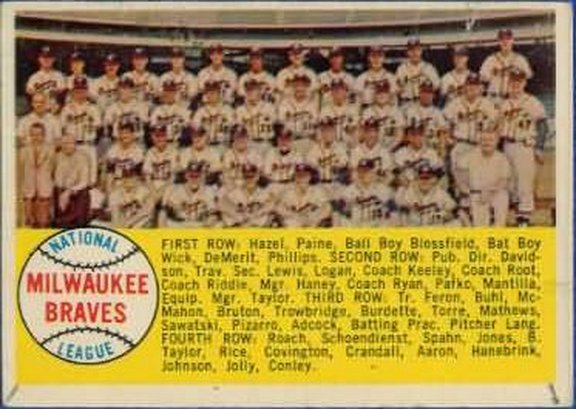
Team cards in this set are different from Topps' previous sets. The players' names are listed on the front, as in 1956, and the team name is shown inside a baseball-shaped graphic. A notable difference is shown with the team cards for the Giants and Dodgers. While the other 14 team cards feature city names, the other two are shown as "1957 Dodgers" and "1957 Giants." This reflects the fact that both teams moved west prior to the 1958 season. The main difference in the team cards is that the backs feature checklists; for the previous two years, Topps printed separate checklists. Four teams in the fourth series (Braves, Tigers, Orioles, and Redlegs) can be found with either alphabetical or numeric checklists.


Card #377 -- Milwaukee Braves Checklist

Speaking of variations, the 1958 Topps set is loaded with them. In addition to the checklist variations, there are 33 cards from 2-108 that feature either player or team names in yellow letters, instead of the more common white letter variation. Many of these variations feature Hall of Famers, including Hank Aaron, Roberto Clemente and Al Kaline. The checklist below explains which cards have variations. A scarce variation, and one that doesn't usually get listed in checklists, is card #433. Pancho Herrera's card can be found with or without the letter "a" at the end of his name. The correct variation is a common card, but the error is almost impossible to locate. Finally, when Topps triple printed the Musial and Mantle All-Star cards, they short printed four cards (443, 446, 450 and 462) to accommodate them, making those cards slightly scarcer.

There were also cards inserted into the packs for gum wrapper redemptions, suck as this one for felt team emblems:


Finally, here's an example of a five-cent pack from 1958:


Compared to Topps' other sets of the 1950s, this set is one of the easiest to complete, if you try to complete the basic 494 card set. Unlike most of Topps' early sets, there are no high-number scarce series. Instead, collectors find the first 100 cards to be the hardest to locate. Getting all of the yellow-letter and team variations is tougher but not impossible, but completing the set with the "Herrer" error is quite a challenge.

Friday, June 1, 2012

Q&A -- Jersey Variation

Here's an interesting question sent in by Brian:

Q:

"I have a 1934-36 Diamond Stars #82 John Babich (Blue Back) without the Brooklyn on the front jersey.  Is this card an error?  If not can you tell me why this might be?"

A:

I don't own the card, so I had to make a quick online search. Sure enough, the cards found had both variations. Here he is with the team name:


And here he is without any designation on his jersey:


To answer the reader's question, it's not an error card (technically, nothing is wrong, so by definition it can't be an error). What this is would be a variation. While errors and variations are often lumped together by hobbyists, there's a distinction nonetheless.

During my (unscientific) online research, the backs of the three "non-Brooklyn" variations all had a blue back from 1936, but none of the others did. Since Babich's card was one of many in the set with three different back variations, it's possible that the name was removed during the last printing because he was traded to the Boston Braves before the 1936 season. There wasn't a way to produce a new card in time, so National Chicle "fixed" the problem by altering the jersey.

However, this is speculation, so I'm tossing this one out to my readers. Does anybody have any info on this one?