Showing posts with label 1952 topps. Show all posts

Wednesday, December 14, 2011

Hey There Boo-Boo...

It's been a while since I've shared one of the "beaters" from my collection, so here's another one of the cards I'm holding onto while I wait for a more complete version to surface in a price range that is more in line with what I want to pay:


It's what would otherwise be a terrific example of a 1952 Topps Yogi Berra card, but a previous owner decided it needed to match up better with the cards Topps issued after 1956 and trimmed the edges away.

That said, I'll probably be waiting for a while until this one gets upgraded. I can't buy an awful lot of caviar when all I have is hamburger money.

Friday, August 12, 2011

Before We Leave the National...How About a Giveaway?

Since I've been talking up The National Sports Collectors' Convention so much over the past month, here's one last post about it before I move on to other vintage-related posts. And let's make it a giveaway contest.

During the show, I managed to pick up some upgrades for my 1952 Topps set. Here is what I placed in my dupes box:

1952 Topps #124 -- Monte Kennedy, New York Giants

This card was trimmed to keep the "marquee" design, and the rest was rounded as an artistic statement.

1952 Topps #249 -- Bobby Adams, Cincinnati Reds

On the other hand, this Bobby Adams card has been trimmed to match the standard-size cards used since 1957. I suppose we should be thankful that the previous owner didn't prefer the size of 1952 Bowman cards. As you can see, the year is also recorded on the card in blue ink.

Both cards are being offered as part of a giveaway. There will be two winners drawn at random, one for each card. To win, simply leave a message at the end of this entry. If you aren't able to post a message (or simply don't want to), I will also accept email sent to the address on my profile. Look at the left side of this blog for my profile, my email address is there.

Any bloggers who advertise this contest will get an additional entry. Please tell me in your comment or send me an email to ensure I don't miss it. I'll close the contest on Sunday Monday evening and announce the winners soon after that.

Good luck to all who enter.

Friday, May 27, 2011

Q&A

I was posed this one a while back by a hobby friend named Richard:

Q:

"I have a question and maybe you are just the guy to have an answer:
 

I am seeing a lot these days on ebay of '52 Topps cards that are reprints but virtually impossible to tell from the real thing.  This is scary - how can we collectors know if we are getting the real thing unless the seller is knowledgeable and honest?"

(Judging from the condition of my own 1952 Topps cards, reprints are the least of my worries. I'm usually glad when they're all in one piece.)

A:

The "reprints" seen on eBay are usually the high-dollar ones like Mantle. Since even a beat-up Mantle can fetch a considerable sum, an unscrupulous seller may feel it's worth the effort.

My answer is going to be different, since I've stopped doing eBay (I haven't quit, I just don't find myself there all that often). I buy my '52 Topps cards in person and have seen and felt enough of them that reprints can be fairly easy to identify. Dealing with sellers I trust probably tilts the scales in my favor as well. However, if I were buying them online and didn't know the seller, I'd look for some things:

1. If the scans appear fuzzy or out-of-focus, I'll assume it's not good or that something is being hidden. Maybe asking for a larger, clearer scan can help. Many fakes have different fonts that will show up in a scan. Of course, if a seller either doesn't respond to your request or refuses to produce a better scan...he's either hiding something or just doesn't want your business.

2. For some higher-dollar cards (or high numbers), it may be a good idea to buy them graded. While many of my own cards won't grade all that highly, there are '52 Topps cards out there that are graded anywhere from A (authentic) to 5-6 that in some cases are less expensive than buying them raw. If you see a good deal, you can always -- carefully -- break them out of their holders if you don't want them.

3. Again, deal with sellers you know and trust. If you have questions about anybody, ask your friends, especially the ones who buy similar items. Online trading groups are good places to start, as are online forums such as Net54 and CU. If somebody's been treated badly, they'll jump up and say so.

Good question.

Friday, April 1, 2011

Q&A

Here's an email I received through my Website:

Q:  

"Was Andy Pafko such a great ballplayer?  He's not in the Hall of Fame, so why is his 1952 Topps card so expensive?"

 
A: 

Pafko was a capable fielder and dependable outfielder who played in the National League between 1943 and 1959. He was a five-time All-Star (1945, 47-50) and a lifetime .285 hitter. He came up to the majors and excelled at a time when many of the game's stars were serving in the military, but unlike many 4-F players of that era, he was good enough to stay in the majors once the stars returned from wartime duty. His career numbers aren't particularly impressive, and he has absolutely no chance of induction into the Hall of Fame. Cubs fans will point out that Pafko was one of the guys that took to the diamond the last time the Cubbies appeared in the World Series (in 1945). While the Cubs never returned to the Fall Classic, Pafko did three times -- with the Brooklyn Dodgers in '52 and in back-to-back seasons with the Milwaukee Braves ('57-'58).

The reason Pafko's '52 Topps card is so valuable is because of its position as the #1 card in the set. Back in the days before price guides and professional grading, most collectors really didn't pay attention to taking care of their cards. Many set builders would simply wrap their collections with a rubber band or two, and whatever card was at the top of the stack would get the most damage (the card at the bottom of the stack received most of its damage on the card back, so the damage wasn't as severe). Invariably, the card at the top was most likely card #1 of the set.

Another factor that affects the price of Pafko's card is the Brooklyn Dodgers logo. Collectors of 1948-57 baseball cards generally accept a higher price tag on player cards for all three New York City teams of the era, because those three teams (but especially the Yankees and Dodgers). In the realm of 1950s baseball cards, players like Charlie Silvera, Billy Cox and Clint Hartung have slightly higher card values simply because they played on New York City teams.

In terms of availability, Pafko's 1952 Topps card isn't any scarcer than any other card the the first series. Like all cards numbered 1-80 in the 1952 set, it can be found with either a black or red back. Its high price is not a result of scarcity.

The Pafko card isn't scarce; it's simply hard to find in top condition. It's commonly found with edge and corner wear, and if you don't have a problem with card condition, it won't cost you all that much to get.You just may have to be patient to find it at the right price, however.

Friday, December 17, 2010

Q&A

Richard writes:

Q:

"I am wondering what the difference in the red and black 1952 Topps would be. Is it that the area around the name and number on the back is black and on the others red?"

 A:

 First of all, thanks for giving me an excuse to pull out my 1952 Topps binder. Granted, there usually doesn't need to be a pressing need to get them out, but I digress...

The first series of 1952 Topps cards consisted of 80 subjects. Their backs were printed entirely with black ink:


During the print run, Topps tweaked the design. Part of the reason was out of necessity, since cards #48 and #49 had their biographies reversed. At the same time, it was determined that a splash of red ink would make the cards really stand out. So, this was the result:


That definitely made the cards easier to read. Topps kept the red ink for the backs through the rest of their six series in 1952. Only cards #1-80 can be found with either black or red backs. The exception: the errors on #48 and 49 are only found with black backs.

The backs weren't the only place to get a reworking, though. Looking at the above two cards side-by-side shows another slight improvement:

(Both of these men were U.S. Army lieutenants during World War Two)

The Elmer Valo card was a black back, while Spahn features the updated back with red ink. A close look at the skin tone shows that Valo's picture is more subdued, while Spahn's is brighter. Whether that was a conscious design change or merely a result of the printing changes, it certainly makes the classic 1952 Topps design more appealing.

Wednesday, November 17, 2010

Mail Call and a Free Card Offer

I received a package in the mail that I really appreciate. I would have really loved to have it here last week, though, because a couple things would have fit in so well then. I'll explain:

A trading buddy (who is not another blogger) sent along these cards in exchange for a 1941 Play Ball card:


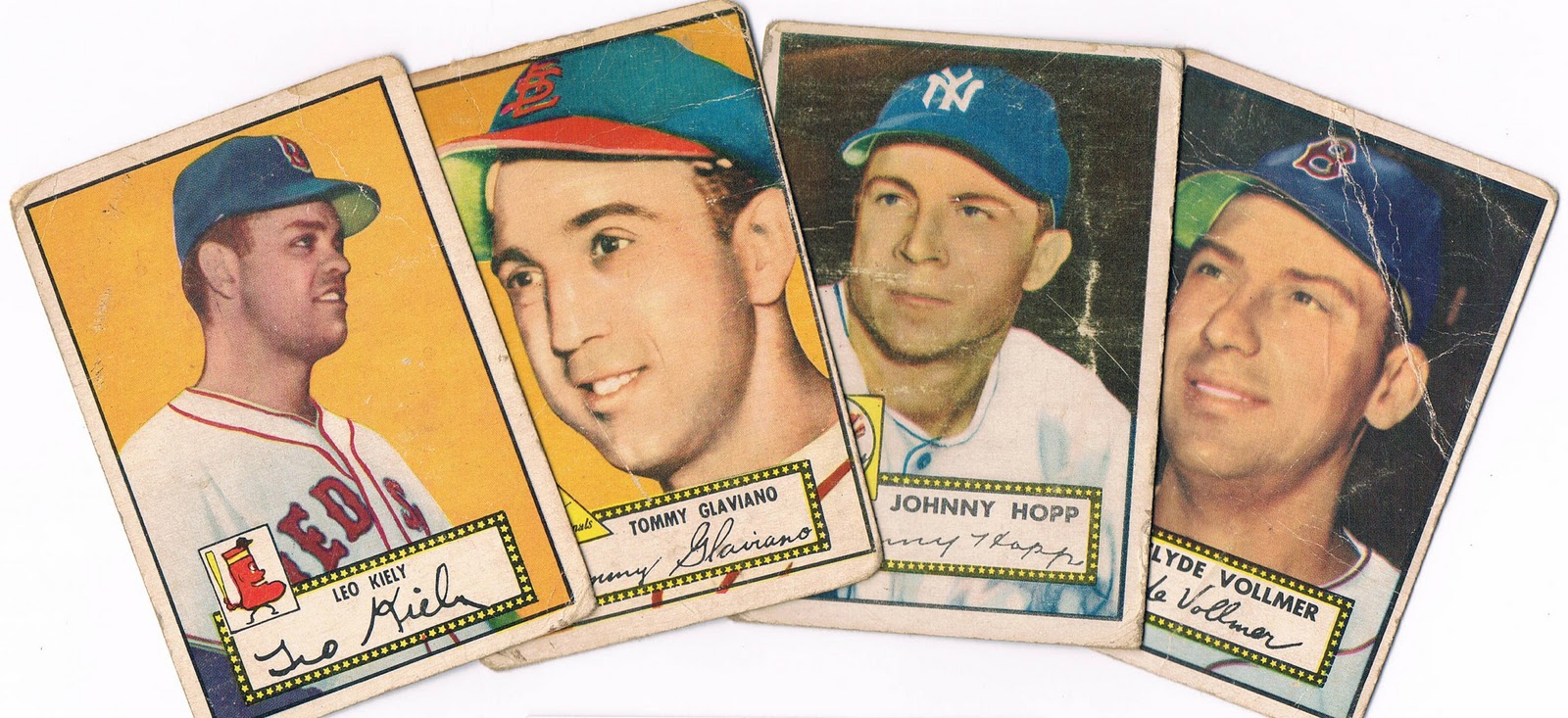
They're not pretty, but every step closer toward the 1952 Topps set is a positive direction. But there was a significance to this package: these four cards took my wantlist for the set down to 202 needed. These cards moved me past the halfway point, which is huge. I do realize that the set is beginning to get an awful lot harder to add to (I still have 95 high-number cards and a lot of Hall of Famers to pick up), but I'll keep looking to get more when I can.

The card at the left features Leo Kiely of the Red Sox. Last week, I mentioned him as the first American-born player who wasn't ethnically Asian to play professional baseball in Japan. That card would have been a great image to place in the blog entry.

Ryan also sent this card along as a surprise:

It's a business-card sized reproduction of a book cover, signed by former player Lou Brissie (also a player in the 1952 Topps set). If you aren't familiar with Brissie's story, it's an interesting one. He was one of many baseball players from all levels who served in the military during World War 2. In December 1944 he was serving with the Army's 88th Infantry division in Italy. One night, his unit came under fire from German artillery. One of the shells shattered his tibia and shinbone.

Brissie was evacuated on a stretcher and sent to a field hospital, where the doctors considered amputating his leg. Somehow, Brissie managed to convince them to save it during the operation. It took two years and 23 operations, but he regained enough strength to play baseball again. He was signed by the Philadelphia A's and made the big leagues in 1947.

Had I been able to get this last week, this could have been a great thing to show on Veteran's Day. Overcoming that kind of an obstacle is a story that's worth being told. If this has interested you in the book, here's a link to check it out on Amazon:


And many thanks to Ryan for sending this stuff my way.

And...while we're on the subject of trades...Here's an offer that ties into Monday's post about my oldest card.

A while back, I had a post showing some of the gems I have in my duplicates box. Here's the picture from that post:


Two 1952 Topps and one 1953 Topps, which have been given an after-market adjustment by a young owner and a pair of scissors. I'm looking to find some good homes for them. These are open -- for free -- to anybody who wants one. I'm not even asking for anything in return for these.

There's a catch, though: this must be the oldest card you own when you get it.

Simply leave a comment indicating which one you want. It there are three comments (or only one for any particular card), I go in order of the first post. If there are more than one people claiming any of these cards, I will use another time-honored method involving paper, scissors and a hat (and let my daughter do the honors).


Additionally, I'll even give one extra chance to any blogger who lets me know he's listed a link to this giveaway in their blog (leave a comment about it or send me an email so I know, and tell me which card you want). And since this blog isn't always the first thing anybody reads, I'll give this a few days to run. The cutoff is 6:00 P.M. Eastern time on Sunday, November 21. I'll announce the winners on Monday.

Friday, October 1, 2010

Q&A

Q: "Could you explain the Joe Page/Johnny Sain errors in the 1952 Topps set?"

A: When the first series of the '52 Topps set was produced, mock-ups of each card were laid out on a sheet before being printed. According to the legend, the proofreader (or a printer's assistant) dropped two of the biographies and inadvertently switched them when they were returned to the sheet. As a result, the first printing featured incorrect biographies for cards #48 (Joe Page) and #49 (Johnny Sain).

For years, I had assumed the card backs were switched. I was amused to find out several years later that not only was I wrong about that, one of those errors actually resided in my own collection for more than ten years without being detected. That was quite a surprise for me.

Here's Johnny Sain's card:


You can see a hole at the top where a tack once went through it and the centering issues -- in this case, a "diamond cut" -- that frustrate many high-end collectors of this set.

Now take a look at the back of Sain's card:


While the back says "John Franklin Sain" and has the correct vital statistics, read the biography a little closer:


It says "Joe" instead of "Johnny." Not only that, but it mentions relief duties with the Yankees since 1944 when Sain was renowned for his spot in the Boston Braves' late 1940s pitching rotation ("Spahn, then Sain, then pray for rain"). The error was corrected, with the incorrect backs being scarcer (and more valuable).

Lastly, all 1952 Topps cards between 1-80 come with two different back colors, all-black or red and black. The Sain/Page errors were fixed before the color change was made, so no bio errors are found with red backs.

Friday, June 18, 2010

This Card's Too Big...

Now, most collectors know that in the 1950s card sizes were all over the place.

In 1950, Bowman had a nice, almost square card. They made them taller in '51 and then Topps came out with huge cards in'52. So Bowman had to make theirs bigger in '53. So, after '56 Bowman is gone and Topps decides to cut down the cards to a smaller size.

Let's say you didn't care for those '52-'56 cards. Perhaps they were too big and didn't fit right in your pants pockets. Maybe it just bothered you that they were so much bigger than your cards from '57 and later. To a kid, all you need is some good ol' American ingenuity and a pair of scissors.


Problem solved.

Friday, May 7, 2010

RIP Robin Roberts

This has been a sad week for baseball fans. First, legendary broadcaster Ernie Harwell has gone behind The Golden Microphone in the Sky, and now I've learned that Robin Roberts has also passed away.

Better writers than I have written moving tributes to both men, so I won't add to the philosophical wind that always picks up when legends depart. However, I do have a card to share.

When I was in high school and beginning to collect more vintage material, I picked up 1952 Topps cards when I could get them cheaply. I picked up my first two '52s in the Summer of 1988, but I wouldn't pick up my first Hall of Fame player from the set until the next year. At $6 I thought it was quite a steal.

In fact, I still do.

Rest in Peace, Mr. Roberts. You may have been called up to pitch in the Field of Dreams, but you'll be missed here.

Thursday, May 6, 2010

Pop Quiz! And Another Gem...

Time for a quick question...but no worries, I won't keep score and won't tell if you get it wrong.

Here's a quote:

"The trouble with baseball today is that most players are in it for the money; not for the love of it, the excitement of it, or the thrill of it."

These words were spoken by a Hall of Famer near the end of a storied career.  Can you guess who said it?

A) Robin Roberts, in 1965
B) Johnny Bench, in 1981
C) Nolan Ryan, in 1992
D) None of the above

Think it over for a second...and while you're doing that, here's another gem from my collection:

This is a high number from the 1952 Topps set. These usually sell for $150-250 and this one looks great, especially when you consider some of the other cards I've already shown here. I purchased this card for $4 and from a brick-and-mortar hobby store. Would you like to know how?


It appears the store owner didn't check to see what the number was. Since the back had damage from being placed in a scrapbook -- there's both missing paper and extra paper -- he priced it according to how the front looked. There really was no excuse, as he merely needed to scan one of the catalogs he kept on hand for Hearn's name.

That was quite a surprise when I took it home and went to look at my own checklist.

Now for the answer to the question above:

The answer is...D) None of the above.

The quote was a statement made by Ty Cobb in 1925! So when somebody tries to tell you about how players were more into baseball for the love of the game during the 1950s/'60s, you can tell them that as long as players needed to pay their bills...money has been an issue in the sport. For what it's worth, even when the game was an amateur sport during the 1800s, there were certain players who had "agreements" with club owners where they would be given a job title and salary with the owner's business specifically in exchange for filling a roster slot on the baseball club.

I guess the saying is true; the more things change, the more they stay the same.