Showing posts with label QandA. Show all posts

Friday, August 24, 2012

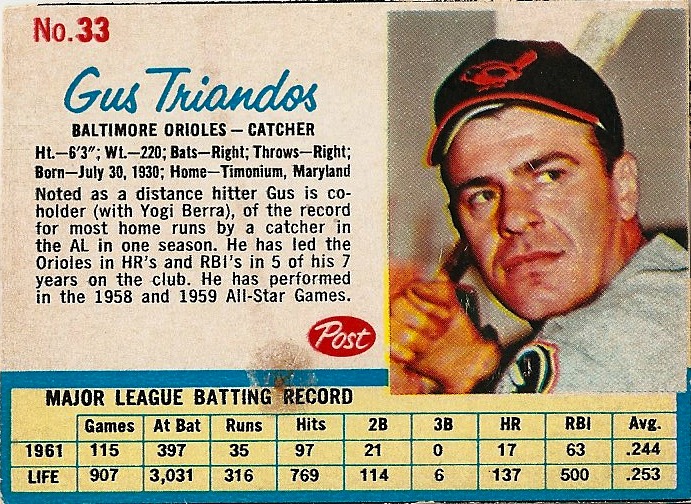
Q&A -- Gus Triandos Card

Today's question comes to me through my position in OBC as the "card identification guy":

Q:

"I have a Gus Triandos card with plain cardboard back done by Post the year is 1961. I have never seen a card like this. Do you have any info on this card?"


(There was no scan with the email, so I cribbed this image from the Orioles Card "O" the Day blog. Hope that's OK, Kevin.)


A:

Post cereal placed cards on the backs of various cereal boxes in the early 1960s. If your year shown on the card is 1961, then it's the 1962 Post set that your Triandos card is from. He is featured on card #33 in that set, and #69 in the '61 set. Here's a link to an explanation of the set, as well as a neat TV commercial about them.


Here's the link to the other Post set checklists, if you've never seen this type of card before.

Friday, July 13, 2012

Q&A -- T207 Cleveland Players

Today's question comes from Paul:

Q:

"Could you provide me with a list of players with the Cleveland Indians from this set? thanks in advance for any help you can provide."


A:

Although they weren't called the "Indians" until 1915, here's a list of the Cleveland players in the 1912 T207 set:

Bert Adams
Neal Ball
Joe Birmingham
Fred Blanding
Hank Butcher
Harry Davis
Ted Easterly
Lefty George
Jack Graney
Vean Gregg
George Kaler
Paddy Livingstone
Willie Mitchell
Ivy Olson
J.B. Ryan
Terry Turner

There are some variations if you're a master set collector. Harry Davis is found with either a brown or blue "C" on his cap. Paddy Livingston has two sizes of the letter "C" on his shirt, as well as an "A" variation because he had been traded from Philadelphia. All the cards have the same back variations found in the set as well. My Website fills in some of the details.

As for the team nickname, in 1912 they were still officially called the Naps in recognition of player/former manager Napoleon Lajoie. Lajoie doesn't appear in the set at all, and neither do a lot of stars, which diminishes the appeal -- though not necessarily the value -- of T207 for some collectors.

For all of the T207 team lists...TeamSets4U is a great reference. And the owner (Jeff) is one of the good guys in the Hobby.

Friday, April 13, 2012

Q&A -- "Regular Size" T3

Today's email comes from a reader named Jeff:


Q:

"I have come across a smaller version of what is described as a Turkey Red cabinet card. The card measures 3 1/2" by 2 1/2". It is a #2 Bergen.

Do you know if this could be a reprint?
"

(The image above is a real T3 Bergen that was offered in a Mears auction...and sold for $44)


A:

Yes, it's a reprint. T3s have been reprinted several times in what we now call "standard" size (which wasn't introduced until 1957). Authentic T3 cards are eight inches tall.

Friday, April 6, 2012

Q&A -- Diamond Stars Backs

Today's question comes from Danny:
Q: 

"Hope you can answer this! What are the differences between the two Bill Dickey card #11’s? Both have green backs, so how can you tell? One is listed as 1934 and the other as 1935. Also, I need to know how to tell the difference between the Tony Lazzeri blue back cards, as there is a 1935 blue back and a 1936 blue back? Appreciate the help!"

A:


There are three different dates on many backs because the cards were issued over a three-year period. The date given in the statistics changed over the years but the copyright date at the bottom of the card remained 1934 throughout the run.

1934 is green.
1935 is either blue or green.
1936 is blue.
So, for instance:


The color of the text is green, and the stat date is 1934. So it's a 1935 card. The card you have with 1935 on the back will be from 1936.

Friday, March 30, 2012

Q&A -- Fatima

This email comes from Linda:
Q:
"We were looking through some old pictures yesterday and came across an old baseball card. It is of a single player named 'McBride, Washington.' It was a tobacco advertisement card. Fatima was on it and Pictorial News Company may have been printer. I did find information on a McBride( no first name) who played for Philadelphia Athletics. Do you know any more about this?"
 (Images from an Oct.2007 Huggins & Scott auction)


 A:
From your description of the card, it sounds like a T222 Fatima card.They were issued in 1914 and are pretty rare. Here is a link to an auction for one of those cards: (the same one where the images above appeared). Also, here's a little more info about the set from the Old Cardboard site.

Friday, March 9, 2012

Q&A -- "Looks Like a Regular Picture"

 Here's an email I received last week from a lady named Patty:
Q:
"(I have) 3 cards. They are  #2 of 33 Boog Powell; Willie Horton #9 of 33; Maury Wills #24 of 33.
They look like regular pictures with signed names in blue ink. 
They just have a name and # on back with the words T.C.G. PRTD.IN U.S.A."
A:
Fortunately, having the numbers is a big help here...and yes, I can identify your cards. What you have are 1969 Topps Deckle Edge cards. Here's an example:

As you can see from Roberto Clemente's card from the set, they're black & white pictures that have been given a "scalloped" effect on their edges (or, as Patty says above, they "look like regular pictures," as that style was popular among snapshots taken in the era. A facsimile autograph in blue ink has been added to the front of the card.

The backs are mostly plank, except for a little bit of info along the bottom:


Inside a box, there is a name and a card number, along with the manufacturer's info Patty mentioned in her email.

These cards were included as inserts inside wax packs in 1969, which makes them fairly common. While they're not overly expensive, they are pretty easy to build a base set out of and represent the first complete set from before my birth that I was able to put together.

There are actually 35 cards in the set, however. With 33 total cards, there was at least one player from each of the 24 teams in the league at that point, even though the team itself isn't specifically named in the design. When two of the players were traded, Topps substituted them for former teammates (albeit it by switching the numbers) in order to keep the balance.

As a result, card 11 either shows Hoyt Wilhelm or Jim Wynn and card #22 has either Rusty Staub or Joe Foy. Wilhelm and Foy were both Royals, and Staub and Wynn were both shown as Astros. The later additions -- Foy and Wynn -- are the scarcer versions, but aren't too hard to find.

Friday, August 26, 2011

Q&A -- T207?

This has been one of my most common questions:

Q:

"I have a card from the T207 set of Lewis, Boston. It's the variation with no patch. I see where it originally had a $700 value, but what is it worth today?"

(Here's an image of the card...I'll identify it in a minute.)


A:

The first thing that looks out of place is the part about how it "originally" had a $700 value. How did that information become available? The answer: "It was written on the back of the card":


First of all, there is no way an authentic T207 card is going to have any information on how the card became rare. Nor will it have any information on how much it was worth. In fact, the mention of "T-207" on the back gives away the fact that it's not real; the T207 designation wasn't even given to the set until the 1930s.

This is one of five cards that were reprinted and included in Hygrade hobby kits during the 1980s. Besides this card, there were three T206 cards (Wagner, Plank, "Magie") and a 1933 Goudey Napoleon LaJoie that were reprinted. They were even found with different-colored blocks on the back: the yellow one above, green or red. They were changed to reflect price increases as the 1980s went on.

An authentic T207 card will feature a writeup about the player and an advertisement of one of teh cigarette brands mentioned above. Any vintage card that has an explanation that it was rare...or has a price given on it...is not a real card.

Today, there are cards with manufactured scarcities (serially numbered, "1-of-1" cards, etc.), but they didn't play those games with cards that long ago.

Friday, August 19, 2011

Q&A

Today's email comes from Rich:

Q:

I have found some very old cards. They're 1 1/2 inches wide, 2 3/4 inches tall.  

Names include:
Jennings, Detroit,
Maloney, Rochester,
Downey, Cincinnati,
Quinn, New York,
White, Buffalo
Cross, Indianapolis
Anderson, Providence
Barry, Phila Amer
Starr, Boston Natl
 
These are matte finished, in color, fair condition, etc. Found with other documents dated 1905. Any ideas of value, etc.?
"


A:

Assuming they aren't reprints (and setting the other documents aside for a moment)...

The most common cards of that era are T206 White Borders, which were issued between 1909 and 1911. I'm guessing that's what you have because your cards have both major and minor leaguers.

Here's a Web page describing the set in further detail.

That should give you a better idea of what you have.

As for value...Hugh Jennings is a Hall of Famer so his card will be worth more. However, the value will depend on things like what back advertisement it has and whatever its condition is. That said, the market for your cards is decent and if you were to sell them, they should rake in some good cash as long as they're genuine.

Friday, July 29, 2011

Q&A

Today's email comes from Rick:

Q:

"Spent a week in Arizona and picked up some pre-war cards at a shop down there. Goudeys and Play Balls mostly, so I am now officially collecting a few pre-war sets. No dupes yet but one of the cards he had it the stack was a card or maybe not a card that I can't find in the Beckett. Any help with this is appeciated. The front is a black and white photo of Ping Bodie C.F.-New York Americans, the back says Witmor Candy Company AD about a 80 card set one "picture" in each package of Witmor's Kisses. It feels thick like a card and is about the size of a Tobacco card."

(Not his card, but an image I had of an E121 Bodie to show for the purposes of illustration.)

A:

Witmor is one of the many different backs that are found on the backs of cards similar to E121.

They're not really grouped in as E121 in hobby guides, they're classified as uncatalogued.

Friday, July 1, 2011

Q&A

Today's question comes from Mike, who has found an interesting surprise:

Q:

"I found some old baseball cards in a wall of a building. They are not in real good shape, but they might be worth something. 

Here are the names:


Carl Reynolds
Henry Manush
Frank O'Doul
Fred Schulte
Oswald Bluege
George Wahlberg
Bill Terry
George Blaeholder
Carl Hubbel
Joe Moore
Willie Kamm

That's some of them. They are Big League chewing gum cards. There are also some Indian cards."

(This player has the highest lifetime batting average for somebody not named "Shoeless" Joe Jackson who still isn't in the Hall of Fame.)


A:

Sounds like you have some 1933 Goudey cards. Here's a link to a page that describes them and gives a checklist (so you can check the card numbers to be certain):


In VG condition, the common cards from this set go for $5-15 each, but Hubbell and Terry are Hall of Famers and should get more. Likewise, O'Doul was a big star whose major league career was short for the Hall but still phenomenal. I'd suggest looking at completed auctions on eBay to get a good idea of what people are paying nowadays.

Friday, June 24, 2011

Q&A

If you're a seller and disagree, feel free to leave a comment to tell me why I'm wrong. This blog can use some spirited discussion.

This week's question comes from Rick:

Q:

"I was at my local card shop to pick up a Namath rookie (most expensive card I ever bought) and ended up talking about marked checklists, since the highest book card of the 20 I have to go for my 1965 Topps football set was checklist no. 1 (#87).  The NM book on checklists are high because it is so hard to find unmarked checklists.
 

But, what is the value of a neatly marked checklist that would otherwise be NM?  Is 25% of NM reasonable?  For example, the 1965 Topps football #87 books for $175.  Is a neatly marked, otherwise NM one valued at $43.75 (25% of $175)?  What about it if is sloppily marked; I'd say 10% vs 25% for a neatly marked one.  I'm interested in your thoughts on this."

(Examples from my own collection...From left to right: 1966 Topps, 1969 Topps, 1972 Topps. Of course, none of these would be mistaken for Near Mint without the marks. No, I didn't mark these up myself.)
A:

According to the same price guide that contains those prices, ink markings on a card (even neatly done) mean they rate in the G/F/P range. And cards from 1960-present in that condition get 5-10%. Yes, it can be argued that an autograph placed on the card would also fall into the same category, but that's a  topic for another Q&A.

That said, $43 is really high and I'd still have an issue with paying $8.75 to $17 -- which is 5-10% of $175 -- for a marked checklist. But then again, I'm a cheap SOB. The final decision as to whether you take the plunge depends on your own thought process; it's totally up to you to figure out what you'll pay to complete your set.

If a seller ever pulls out a Beckett to show you an inflated value as a way of underscoring what you consider to be a high price, simply take that same magazine out of his hand (but do it politely...it's still his store, after all) and flip over to the section where they discuss condition. It's hard for them to argue when it's in black and white.

Personally, it's my opinion that marked checklists aren't rare enough to warrant a premium. I've picked up marked checklists from that era in the commons boxes for less than a dollar. In fact, none of the checklists shown above were picked up for more than 50 cents.

Friday, June 17, 2011

Q&A

When you have a website that gives information about baseball cards, it sometimes leads to emails asking about values. While I generally avoid giving pricing info, this one made me think about how the laws of supply and demand have affected the hobby:

Q:

"I have some baseball cards (1989 Donruss in the original box and 1988 Score cards in original plastic wrapping) and I was wondering if you could give me a rough estimate of what they might be worth. I've attached a picture to this e-mail. Thanks!"

(My rough count tells me there are 36 unopened '88 Score packs in their original cello wrappers in this photo, which is the same amount as an unopened box contains. And that is definitely the box used for the '89 Donruss factory set.)
A:

Sadly, since there is no shortage of unopened late 1980s material, the prices on 1988 Score and 1989 Donruss haven't done well over the years. In 1988, I bought packs of Score for 40 cents (plus New York's then 7% state sales tax) from a family-owned store just around the corner from where I lived. My copy of Baseball Cards Monthly magazine from May 1989 offers a complete '89 Donruss set from several sellers at anywhere between $22.95 and $29 (plus shipping and handling).

Today? Well, according to this site, there is no need to do a "rollback" sale on unopened packs of Score. They're worth about the same amount they sold for 23 years ago. Dozens of boxes sit on eBay with "Buy it Now" prices of $18 (which comes to 50 cents a pack) and stay unsold.

As for the '89 Donruss factory set...this seller is offering them for $11.95, which is less than half what they fetched when they were brand new.

Back in the late 1980s, unopened material from the past sold for a lot of money. It encouraged people to stock cases away in the hope that they would also appreciate in value. However, so many unopened cases were set aside that the supply never had a chance to dwindle from natural attrition. At the same time, kids weren't torturing their cards in 1989 the way kids in the 1950s and 60s did. They weren't flipped against walls or placed in bicycle spokes all that often. Their mothers weren't tossing out their collections when they went to summer camp. And manufacturers were releasing enough cards to allow every man, woman, child and family dog in America to have two of them. At the same time, the prospects in those sets -- Gregg Jefferies, Sam Horn, Mike Greenwell, Al Leiter, et. al. -- didn't turn into Cooperstown-bound legends. And of those who did better (that '89 set contains rookie cards of Ken Griffey, Jr., Curt Schilling and Randy Johnson, who are likely to be first-ticket HOFers), the glut of material has prevented their cards from making the same 20-year gains we saw in the 1980s.

The supply is so high and the demand so low, I'm not sure when -- or even if -- the prices will ever trend upward.

Friday, June 10, 2011

Q&A

Today's question comes from a visitor to my website that signed himself "Confused."

Q:

"I have a  "Barry, Philadelphia" card that looks like the t205, but has Hassan on back and John J. Barry with a white border, not the gold. What the heck is this card?"

(I have cards like that as well. Here are some examples.)

A:

Your card is a T202 end panel that has been cut away from the rest of the card. Here's a page explaining the T202 set. Their value is greatly impacted since they're no longer whole, but they offer a great way for collectors to pick up 100-year old cards for relatively little money.

Friday, June 3, 2011

Q&A

A visitor to my website who lives in Pennsylvania sent this one:

Q:

"I have an old item with Three-Finger Brown's photo on it.  It just says,  Brown, Chicago on it.  It is about 1 1/4 inch square on heavy cardboard and  appears to have been cut out from a candy box etc.  The item was  returned by PSA a few years ago and I was told it was not gradable but didn't give a reason.  I  am attaching a scan of it for you to see and wondered if you  could give me  any information on this item?"


A:

Your card looks like it's from a set issued in 1907. It's a "strip card" known to the hobby as W555. Truthfully, I haven't seen a whole lot of these, but a great place to start would be the Old Cardboard website's description of the set. It mentions that an "average" card would sell for $35 in VG condition, but Brown is a Hall of Fame player and should sell for more than that.

Friday, May 27, 2011

Q&A

I was posed this one a while back by a hobby friend named Richard:

Q:

"I have a question and maybe you are just the guy to have an answer:
 

I am seeing a lot these days on ebay of '52 Topps cards that are reprints but virtually impossible to tell from the real thing.  This is scary - how can we collectors know if we are getting the real thing unless the seller is knowledgeable and honest?"

(Judging from the condition of my own 1952 Topps cards, reprints are the least of my worries. I'm usually glad when they're all in one piece.)

A:

The "reprints" seen on eBay are usually the high-dollar ones like Mantle. Since even a beat-up Mantle can fetch a considerable sum, an unscrupulous seller may feel it's worth the effort.

My answer is going to be different, since I've stopped doing eBay (I haven't quit, I just don't find myself there all that often). I buy my '52 Topps cards in person and have seen and felt enough of them that reprints can be fairly easy to identify. Dealing with sellers I trust probably tilts the scales in my favor as well. However, if I were buying them online and didn't know the seller, I'd look for some things:

1. If the scans appear fuzzy or out-of-focus, I'll assume it's not good or that something is being hidden. Maybe asking for a larger, clearer scan can help. Many fakes have different fonts that will show up in a scan. Of course, if a seller either doesn't respond to your request or refuses to produce a better scan...he's either hiding something or just doesn't want your business.

2. For some higher-dollar cards (or high numbers), it may be a good idea to buy them graded. While many of my own cards won't grade all that highly, there are '52 Topps cards out there that are graded anywhere from A (authentic) to 5-6 that in some cases are less expensive than buying them raw. If you see a good deal, you can always -- carefully -- break them out of their holders if you don't want them.

3. Again, deal with sellers you know and trust. If you have questions about anybody, ask your friends, especially the ones who buy similar items. Online trading groups are good places to start, as are online forums such as Net54 and CU. If somebody's been treated badly, they'll jump up and say so.

Good question.

Friday, May 20, 2011

Q&A

Today's question comes from Marvin, who asks:

Q:

"I have an American Caramel Company card with name of player in the white border. Is that E-121?  The name is ELMER SMITH ?"

(A different Smith -- I don't have an image of Elmer -- to illustrate what an e121 looks like.)

A:

Elmer Smith did appear in the E121 set.

Here's a page that gives a quick description of the set...they mention two different sets based on the back caption, a "Series of 80" and a "Series of 120." While some players appeared in both series, Elmer Smith did not appear in the "Series of 80."

Friday, April 29, 2011

Q&A

Here's an email I received through my website recently:

Q:  "I have an autographed 1954 Wilson's card of Ray Jablonski. Is it of any value?"


(The image here is not mine...and probably a reprinted card. I grabbed this image from an old file I had. It shows the set design so my answer makes a little bit of sense.)

A:  All the 1954 Wilson cards have facsimile autographs across the front, so that part doesn't add value.

However, Jablonski is one of the harder to find cards in the set. Assuming it's the real thing and not a reprint, then yes, there's quite a bit of value there. Depending on condition (I need a scan to know for sure) it could be worth up to $1000.

Friday, April 1, 2011

Q&A

Here's an email I received through my Website:

Q:  

"Was Andy Pafko such a great ballplayer?  He's not in the Hall of Fame, so why is his 1952 Topps card so expensive?"

 
A: 

Pafko was a capable fielder and dependable outfielder who played in the National League between 1943 and 1959. He was a five-time All-Star (1945, 47-50) and a lifetime .285 hitter. He came up to the majors and excelled at a time when many of the game's stars were serving in the military, but unlike many 4-F players of that era, he was good enough to stay in the majors once the stars returned from wartime duty. His career numbers aren't particularly impressive, and he has absolutely no chance of induction into the Hall of Fame. Cubs fans will point out that Pafko was one of the guys that took to the diamond the last time the Cubbies appeared in the World Series (in 1945). While the Cubs never returned to the Fall Classic, Pafko did three times -- with the Brooklyn Dodgers in '52 and in back-to-back seasons with the Milwaukee Braves ('57-'58).

The reason Pafko's '52 Topps card is so valuable is because of its position as the #1 card in the set. Back in the days before price guides and professional grading, most collectors really didn't pay attention to taking care of their cards. Many set builders would simply wrap their collections with a rubber band or two, and whatever card was at the top of the stack would get the most damage (the card at the bottom of the stack received most of its damage on the card back, so the damage wasn't as severe). Invariably, the card at the top was most likely card #1 of the set.

Another factor that affects the price of Pafko's card is the Brooklyn Dodgers logo. Collectors of 1948-57 baseball cards generally accept a higher price tag on player cards for all three New York City teams of the era, because those three teams (but especially the Yankees and Dodgers). In the realm of 1950s baseball cards, players like Charlie Silvera, Billy Cox and Clint Hartung have slightly higher card values simply because they played on New York City teams.

In terms of availability, Pafko's 1952 Topps card isn't any scarcer than any other card the the first series. Like all cards numbered 1-80 in the 1952 set, it can be found with either a black or red back. Its high price is not a result of scarcity.

The Pafko card isn't scarce; it's simply hard to find in top condition. It's commonly found with edge and corner wear, and if you don't have a problem with card condition, it won't cost you all that much to get.You just may have to be patient to find it at the right price, however.

Friday, March 25, 2011

Q&A

Bill writes:

Q:
"I have come across about 20 baseball cards (Lou Gehrig, Ty Cobb, etc) that have a copyright date of 1950 and B. E. Callahan on the back.  The cards are about 1 1/2 inches wide and 2 1/2 inches tall.  They are black and white.  The pictures are like an ink drawing. The back has a bio of the player.

Can you steer me in the right direction to find out more about these cards?  I can't find anything about these cards anywhere.
"


A:

Your cards are from the 1950-56 Callahan set (W573 in the American Card Catalog). They were issued as a boxed set through the Baseball Hall of Fame in Cooperstown, NY and featured every member then enshrined in the Hall. Each year, the new Hall of Famers would simply be added to the set. In other words, cards of Dizzy Dean (inducted in 1953) are harder to find than those of Babe Ruth, Jimmy Foxx, Cy Young and all other pre-1950 inductees, because his card was added to the set in 1953. Additionally, Hall of Famers who were inducted in 1955 and 1956 -- which includes Joe DiMaggio -- are the hardest players to find. 

There really is little information about this set, probably because many collectors stay away from cards that feature retired players (and in the case of this set, executives and umpires as well). The cards are not really expensive compared to other early-1950s sets, and are worth seeking out if you have an interest.

Friday, March 18, 2011

Q&A

Rob from New York asks:

Q:

"Today I went to the White Plains show and saw a few 1965 Topps Embossed...Should I do the set or not? I need some help on this one...I liked  these guys.  Can you tell me a little about these cards? I know nothing  about them."

Card #3 -- Max Alvis, Cleveland Indians


A:

The 1965 Embossed is a nice set to collect if you're not overly condition-conscious.

For starters, they're considered ugly by a lot of collectors because the players on the cards really don't look like they guys they're supposed to represent.  They're known to be damaged easily (like T205s -- the gold leaf they used to emboss the cards can be chipped easily if you're not careful), so a lot of collectors don't bother with them.  The demand is low, so the prices are, too.

With only 72 cards, it's small enough to keep you from spending a fortune on commons.  It's also one of the best places to get a Mantle card from his playing days for around $20-25 if you look closely.  Good luck on the set if you go after it.