Monday, January 31, 2011

And the Winners Are...

Last week, I ran a giveaway contest in commemoration of my 50th follower. It was a success beyond my expectations. Not only did it become the single most-viewed post on this blog in a matter of two days, I got an additional 11 followers to join up as well.

I may consider a similar giveaway once I reach 100 followers, so those eleven new readers make a significant step towards that milestone. In any case, thanks to all who entered.

In my original post, I mentioned that the winner would be chosen from random using a low-tech method involving paper, scissors and a hat...but the participation in the contest made me resort to more sophisticated means. After the 47 comments to my blog, the extra entries for those who announced the giveaway on their own blogs and a couple of email entries that came in from readers who have issues with giving personal information to Google (no penalty for that), there were more than 60 entries to choose from.

I went over to Random.org to help with this one. Writing all the entries into a program, it generated a random numbered list. Then, I had it pick three numbers for me, and we had our winners. So, without further pause:


The first name drawn was Mariner1. On his Emerald City Diamond Gems blog, he had already mentioned he was hoping to get this Clemente card.


The second name drawn was Cynical Buddha. He had also given a heads-up post about the giveaway on his Collectors Crack blog. This 1955 Bowman Kell card is now his.


The third name drawn belonged to Matt Hickes, who is now the owner of this Burger King card from 1978. Unfortunately, Matt hasn't linked an email address to his profile so he's the only winner who hasn't gotten an email notification. So, congratulations to him!

If Matt could kindly send an email over to me (Chris Stufflestreet at yahoo dot com, just make sure there's no space in my name), I'll begin the process of sending your card to you.

And thanks again to all who entered.

The Box Set -- A Hobby Artifact of the 1980s

Those of us who were around in the hobby during the 1980s definitely remember the Box Set. They were 33 or 44-card sets packaged in a box and sold at retail stores for a few dollars. At first, only Topps made them, but Fleer also got into the act around 1987 and there were so many box sets by the time the 1990s rolled around, they were a joke among hobbyists.

It all started out innocently enough, though.

The very first box set was the 1982 K-Mart set. It was a way to help the retailer celebrate its 20th anniversary. The cards looked like this:


The cards featured the MVPs of both leagues from 1962 through 1981, featured on their Topps card from that year. A couple had to be fabricated, like 1962 Maury Wills and 1975 Fred Lynn (seen above). Wills didn't have a Topps card in his MVP season after refusing to sign a contract with the company, while Lynn had been featured on a multi-player Rookie Stars card and was given his own "unique" card that was only available in that '82 set. Since the MVPs only filled up 41 of the 44 cards in the set ('79 had 2 National League MVPs, so each was given his own card), so three "Highlights" cards were also added to the set. Hank Aaron's card is shown above.

The 44 cards and a stick of gum -- this was Topps, after all -- were placed into this box:


Ah, the "Collectors' Series," a way of trying to encourage mothers to pick up a box and take it home. It wasn't as successful as either Topps or K-Mart hoped. By the end of the year, there were still dozens of these boxes sitting in most stores, marked down to a quarter as a further enticement to get it the hell out of the store.

The back of the box featured a complete set checklist, along with the years of the MVP awards:


This inauspicious beginning in 1982 was the start of a flood by the end of the decade. What started out as a way to get some extra cards sold by Topps and a few extra dollars for a retailer, as well as new cards for player collectors to chase, became a bloated behemoth during the days of runaway card production. In addition to having Topps, Fleer, Donruss and Score packs all over the place in 1988, it seemed every store -- Woolworth, McCrory's, Kay-Bee, Toys R Us -- had its own "special" set, with ever more ridiculous designs as the years went on. Since some of the stores were regional, it could have presented a neat way to get collectors in certain areas in the country to interact with each other...except the dealers grabbed enough to keep them from ever becoming scarce.

Friday, January 28, 2011

Errors and Variations

A while back, I was asked by a person who edits a hobby publication for feedback about errors and variations. He had just gone several rounds with a collector who was trying to get him to add a 1954 Bowman card of Willard Marshall as an error because he's wearing a reds uniform and is identified as playing for the White Sox.

(Here's the '54 Bowman Marshall card for illustration)
 
I'd like to share that here today:


My standard answer is that if the card was never corrected, it really has no extra value as a result. For instance, look at the 1959 Lew Burdette card. It shows Lew as a lefty (he and Warren Spahn swapped gloves on picture day as a practical joke), but the picture isn't a true error. Even then, Lew's name is spelled "Lou" on the card (which Topps repeated in '60). Neither the photo nor the spelling of his first name were changed, so the card has no added value as a result.


On the other hand, there's the 1957 Topps card of Hank Aaron with a reversed negative. A quick look at Aaron's uniform number shows it's backwards. This card has added value over common 1957 Topps cards, but not because it's an error. I'll argue that the 1957 Topps card of Aaron wouldn't be any less valuable today if the negative had been corrected and reversed before the cards were printed...of course, correcting the photo afterwards would have created a different variation and the hobby would have determined whether one variation would be more valuable than the other: like the 1958 Yellow variations and the 1969 Mickey Mantle variatons.


I guess the short answer to your question would be that if the card never was corrected, there really isn't a reason to worry about it as far as the hobby is concerned. Otherwise, we'd be having to list every single "hatless" card of the 1960s, every card that wasn't airbrushed before it was printed (like Don Zimmer's 1962 Topps card with him in a Mets uniform but listed as a member of the Reds) and every card with a typo on the back as an "error" card.


If the collector in question can produce a legitimate 1954 Bowman card of Willard Marshall in a different uniform...then he'd have something.

Wednesday, January 26, 2011

My 50th Follower...Means a Giveaway!

Last week, this blog reached a milestone. In only nine months, it has picked up 50 followers.

While I am of the impression that this blog should be required reading for everybody, I do realize that many collectors don't always spend a lot of time looking at "old" stuff. There is also the possibility that some just don't have a lot of older material in their collections and therefore don't spend a lot of time looking around at stuff they would be tempted to pick up.

Well, let me see if I can help you out with a giveaway.

In celebration of Follower #50, it's only appropriate that the first prize have something to do with the number 50, and we'll go to the set I blog about three times each week:

This is card #50 from the '73 Topps set.

For those who read my 1973 Topps photography blog, this card was featured there last year. It was the last card Topps made for Roberto Clemente and was included in the first series of the '73 set before the news of his plane crash could get it pulled. As a result, the back of the card shows his final career statistics.

This is one of three cards I'll be giving away. The second one comes from the 1955 Bowman set, which was the subject of this article I wrote in SMR in 2007 (the link brings up a PDF file):


Sadly, George Kell passed away in 2009. However, he lives on in the memories of those who watched him play, listened to his broadcasts and collected his baseball cards.

Finally, this one is not quite what it might seem:

It looks like a 1978 Topps card, but it's actually a 1978 Burger King card of Jim "Catfish" Hunter from the final years of his Hall of Fame career.

That gives three vintage Hall of fame cards to give away. They're not "investor-grade" quality, but they're cards that would do better in a collection than in my dupes box. Just to clarify: there will be three separate giveaways (and three separate winners), not just one.

Unlike last time, there are no restrictions to who can enter. All you need to do is enter a comment below. There will be three separate drawings, all involving a time-honored method involving scissors, paper and a hat. Any bloggers who post about this contest will get an extra entry into the drawing. I'll keep this up until Sunday evening and announce the winners on Monday. Good luck!

Monday, January 24, 2011

Cool Vintage Hockey Cards

For a Sportscards blog, I really have given short shrift to basketball and hockey. As of now, I've only had one post related to basketball and nothing to show for hockey. Since I haven't collected much of either (despite a 1970s Basketball wantlist that can be seen from my wantlist links on the sidebar) and despite repeated requests for guest articles here, I've had to simply let them slide. However, it's the baseball offseason and the football playoffs are nearly over...what better time to try and get some of the other sports represented while they're still in season?

These images were shared by a buddy of mine from Ontario:


This Lipton box is from 1974-'75. As you can see, there were two cards that could be cut from the box. In all, there were 50 players (with Borje Salming available with either a horizontal or vertical card, for a total of 51 cards). I'm told they're fairly rare...occasionally the 2-card panels and box backs can be found, but the entire box is rare indeed. As you might expect, many of the cards found were cut from the boxes with young hands and scissors...not necessarily a good combination for maintaining top conditions.

I like the image on that Garry Unger card, which show the puck up close (you can click the image to see it larger). He had some other boxes, including this one:


A classic 1970s pose and Tony Esposito in full goalie gear. Great stuff.

In fact, hockey cards go back as far as the early 1900s. There is some really rich history there, something I'd love to show on this blog as I go along.

Friday, January 21, 2011

Wonderful World of Stamps

Last May, I wrote an entry to this blog about Joe Greene. In it, I mentioned that the NFL players' union authorized three sets to release in 1972 and showed the Greene cards from two of them. At the time, I didn't have any cards from the third...but that has recently changed.

The 1972 NFLPA Wonderful World of Stamps was a set designed to be placed in a sticker album, probably as an item that could be sold at school book sales and in other places that would attract kids' attention. They were actually issued in both 1971 and '72, as there are variations involving players who had been traded or left the team.

There are 390 stickers in the set -- not including those variations -- which broke down to 15 cards for each of the 26 teams them in the NFL. Cards are numbered like the Fleer and Topps sets of old, with players grouped alphabetically by team. In the case of the Steelers, they run from #316 (Chuck Allen) to #330 (Bobby Walden). Here's the back of Bradshaw's card to show his number:


As you can see, there is an instruction to paste the stamp, as it is not pre-moistened. The manufacturer also determined it was unwise to clutter up the back of the stamp with details, as they wouldn't be seen once the picture is placed in the album.

Here is the other Steeler I picked up in the lot:

Ray Mansfield was the regular center before Mike Webster arrived. In fact, "Ranger" was the starting center from 1964 through his retirement in 1976. He was one of the few players who stayed on with the team once Chuck Noll began weeding out players who predated his tenure. He was a part of two Super Bowl-winning teams and a fan favorite who was approachable when he wasn't playing. Sadly, Mansfield died of a heart attack while hiking in the Grand Canyon in 1996.

This post isn't all about the Steelers, though. I had to get an entire lot for those two stamps. Here are some of the others:

Daryle Lamonica was the starting QB for the Oakland Raiders as they developed into one of the best teams in football and played in Super Bowl II. His first three seasons were spent in Buffalo, backing up Jack Kemp. Between his days in the AFL and after that league's merger with the NFL, he finished with a 66-16-4 record in games he quarterbacked. Only Otto Graham has a better winning record than that.

(This card was only issued in the 1971 set)

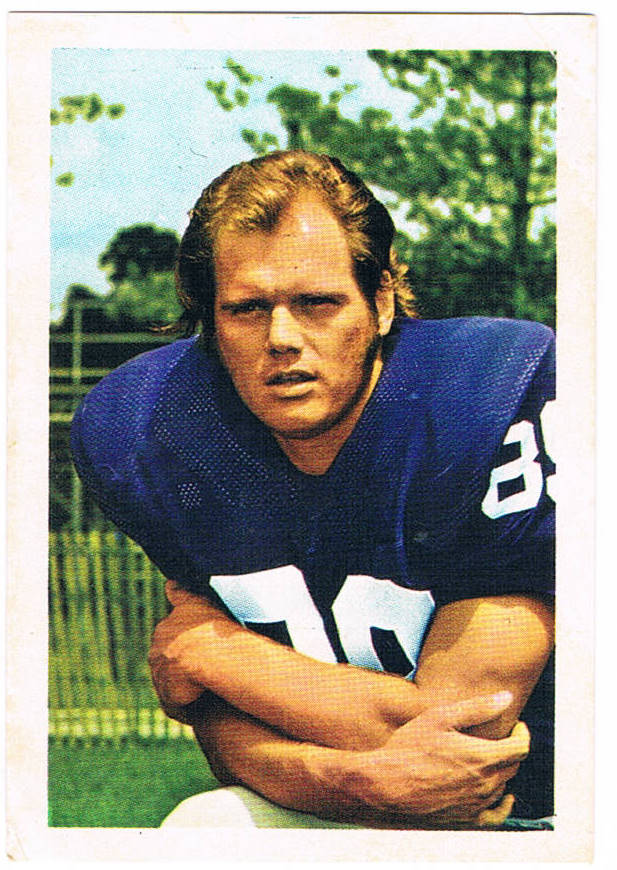
I grew up in the 1980s and remember Fred Dryer as the star of the TV show Hunter. But before he became an actor, he was a very good football player. After three years with the Giants (as shown here), he went to the L.A. Rams and played for a decade there. As a defensive end, he played on a team that allowed fewer points, fewer yards and sacked more opponent QBs than any other team in the 1970s. He would play in one Super Bowl, against the Steelers.

(This card was only issued in the 1971 set)

Tom Dempsey is shown as a member of the New Orleans Saints, but was actually playing in Philadelphia in 1971-'72. He was born without toes on his right foot or fingers on his right hand, so he kicked with a special flattened shoe. This allowed him to kick straight like the old-time players did, rather than the soccer-style kick that had become the standard. In 1970, he booted a 63-yard field goal to win a game for the Saints in the final seconds of a game. It is still the all-time record for a field goal.


Finally, Chuck Howley was a Hall of Fame linebacker from the Dallas Cowboys' glory days and a member of the team's Ring of Honor. Blessed with speed, he was an interception threat, twice getting over 100 yards a season in returns. He's also the only person from the losing team ever named Super Bowl MVP.

I'm only collecting the Steelers, so if anybody is interested in seeing what else I have in the lot (about 35 cards in all) and would like to set up a trade, let me know. It's a great way for team collectors to add to their own stash.

Wednesday, January 19, 2011

Teammate to the Legends

Today, I'll show off a 1934-'36 Batter Up card from my collection:


Card #22 -- "Red" Rolfe, New York Yankees

This card is my only Yankee player from the set. If you'd like to know more about the set itself, read about it on my website.

It shows him as a shortstop, but he was the regular third baseman for the Yankees teams that won four straight World Series between 1936-'39. He played ten seasons with the team (1931, 1934-'42), and appeared in six World Series, winning all but one.

Even more amazing is this fact: at some point in his career, Red Rolfe was literally able to take the field with a an all-Hall of Fame team:

1B: Lou Gehrig
2B: Tony Lazzeri, Joe Gordon
SS: Phil Rizzuto
3B: Joe Sewell
OF: Babe Ruth, Earle Combs, Joe DiMaggio
C: Bill Dickey
P: Lefty Gomez, Waite Hoyt, Red Ruffing, Herb Pennock

That's quite a lineup.

For the record...Joe Sewell is a Hall of Famer as a shortstop, but never played that position for the Yankees. He was the team's regular third baseman from 1932-'34 (and Rolfe took his place once he retired).