Showing posts with label steelers. Show all posts

Friday, January 6, 2012

Cereal-Box Treasures

This weekend, the Pittsburgh Steelers line up against the Denver Broncos for the first round of playoff action. So here are a couple of cards from my collection of Steelers cards:

This Roy Jefferson card is from the 1970 Kellogg's set. It could be obtained either inside a box of cereal or through a complete-set box-top redemption. The 1970 set can be distinguished by the blue helmet and the lack of a border. The background is layered and the Xograph process gives it a three-dimensional look.

Here's the back of the card:


Interesting to see that Jefferson led the league in pass receiving in 1968 and '69, as the Steelers were one of the worst teams in football and traditionally favored a ground attack. That said, these numbers don't include AFL teams, where the most potent passers and receivers were.

The other Steeler among the set's 60 cards includes this quarterback, whose name makes the perennial fourteen year-old boy inside me chuckle:

Dick Shiner's card exhibits the cracks that frustrate the more condition-conscious collectors. Since the process used to give the cards a 3-D look are prone to cracking even if the card has been encapsulated, there are collectors who don't even bother with Kellogg's cards.

Here's the back of Shiner's card:


Unlike Kellogg's baseball sets (which ran every year through 1983), the football sets were issued only in 1970 and '71. The '71s are much harder to find, as they weren't available through the company as complete sets as they were in 1970.

Friday, December 16, 2011

Shiny, But Vintage

Once again, I'll celebrate the weekend by pulling something out of my Steelers collection:


This is a 1970 Topps Glossy card of Roy Jefferson. They shouldn't be confused with the larger-size Topps Super cards of the same year. These were inserted into the first series wax packs of 1970 Topps football cards, with 33 cards making up the complete set. They were printed on much thicker cardboard than the standard cards were and given a heavy gloss, which can be seen in the back scan:


Thanks to being printed on thick cardboard and getting a heavy coat of gloss, these cards are fairly easy to pick up in high grade today.

Monday, December 5, 2011

Snowy-Day Fun

Today, I'll feature this item from my Steelers collection:


It's a 1971 Topps Pin-Up and was inserted into wax packs of that year's football cards. While I usually have no problem with damaged cards, the two creases you see here are found on these, as they were folded twice to fit in the packs.

I will interject that there could have been a better color choice for the card than pink. I know Topps was a company that made its money selling bubblegum, but pink has little place in football. It's like crying in baseball.

Here's the back of the Pin-Up, which has a field and instructions for a football game:


If you right-click the image, you can read the rules and see how the game was meant to be played. I have a couple of questions, though: where the rules mention that the game is played with a "Ball Marker" (as it's called in the instructions), does that mean a game piece was also included in packs...or were the players simply encouraged to use something laying around, like a penny or a piece from the Monopoly game every house seemed to have? Also, I notice that the rules don't say anything about a clock.

One thing I do know...is that the rules mention using cards to determine game play. Those cards were also included in Topps wax packs during 1971:

They even used the same picture on both items for Russell. But longtime Topps fans know they were very good at recycling their images.

Monday, November 28, 2011

The "Leafs" Have Fallen...

For today's entry, I'd like to show off the 1948 Leaf football cards in my Steelers collection:

Card #2 -- Steve Suhey

1948 Leaf football was very similar in design to the company's baseball set that spanned the years 1948-'49. Leaf also issued football cards in 1949, but it was a different issue that contained players who also appeared in 1948. Fortunately a copyright date on the back makes it easy to tell which year the card was printed in case a checklist isn't handy:


The 1948 Leaf set features several college players as well as pros, which is a nod to the fact that the schools were often on a par with the NFL in those days. However, the 1949 set featured no college players at all, and the players who were still in school during the '48 set are shown with their pro teams in '49.

There were three Steelers included in the '48 set. Besides Suhey, there was this player:


This card shows the registration issues that plague the set (as well as the baseball set). In many cards, the colors don't align properly and in some case, they're skipped entirely.

The last Steelers player in the '48 Leaf set is Ray Evans, who was included in the high-number series. Though the high numbers aren't anywhere near as scarce as they are in the baseball set, they're still difficult. As a result, the Evans card is still on my wantlist.

For some odd reason, there were no Steelers at all in the 1949 set.

Monday, September 19, 2011

Disappearing Act -- the Football Edition

There was one really lousy thing about collecting Topps football cards when I was a kid.

They didn't look right. The logos were airbrushed off the helmets, and when I was young I didn't understand why the players on the cards didn't look like they did when they played on TV.

Here's a card in my collection from 1968:


Andy Russell is posing helmetless, as most players of that era did. However, he's holding his "brain bucket" in his hands, and you can see the familiar logo.

In 1970, Topps lost its right to include NFL logos (including team logos) on its cards. It wasn't really noticed that year, as all the pictures used had players in positions without their headgear. In '71, only three cards needed to get the airbrush treatment; since none of the three were Steelers, I don't have one to show here.

In 1972, there was a subset of "Pro Action" cards and an increased commitment by Topps to show "game day" pictures...and they really stand out by how awful they are. And in the high-number set, here's one of the two Steelers:


It's Andy Russell again, but the helmet in his hands has an ominous shadow right where the logo should be. And he seems to be inadvertently giving "the finger" to Topps as an expression of disapproval.

There was one other thing that needed to be removed from some of the cards...


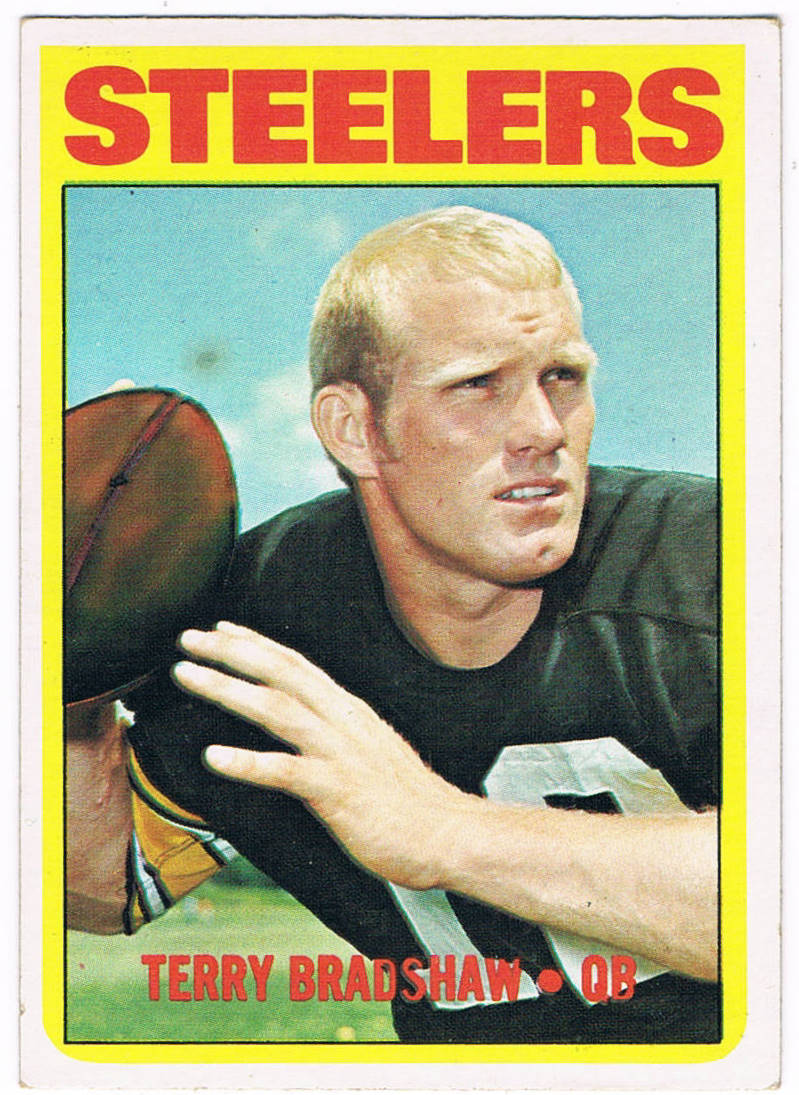
Take a closer look at the football in Terry Bradshaw's hand:


It's been airbrushed as well, in order to get the NFL logo off of the pigskin.

It would take until 1982 before the logos returned to Topps cards. It was a really long decade for football card collectors.

Wednesday, August 31, 2011

One-of-a-Kind "Updates"

As a team collector, I occasionally get a couple of items from other collectors that I wasn't expecting.

Back when the football sets Topps issued were a lot smaller (132-160 cards), there were fewer players available to include and usually didn't get the series treatment that baseball sets did. This -- along with the fact that it took an entire year for players to be shown with their new teams -- sometimes called for collectors to make their own "updates" as they needed.

Here's an example:

1958 Topps #2 -- Bobby Layne

Early in the 1958 NFL season, the Detroit Lions traded their quarterback Bobby Layne to Pittsburgh, which was then a perennial loser. That was likely a blow for a player who had just QB'd his team toward a championship (though Tobin Rote took over at the position late in the '57 season when Layne was injured). Since the cards showing Layne with the Steelers wouldn't arrive until 1959, that was a minor problem for a fan and his ballpoint pen.

As far as him still being in a Lions uniform, that wouldn't matter...since Topps showed him in a blue jersey in both 1959 and '60.

I'm guessing a Lions fan wrote this, based on the way he spelled the team name.

Then there's the player who was skipped over from having a card, like this Hall of Famer:

1970 Topps #3 -- Verlon Biggs

Joe Greene's rookie season was in 1969, and he immediately became an impact player. In 1970, he was an All-Pro player. However, he didn't get a card in the 1970 Topps set, due to the fact that few defensive linemen could get priority over quarterbacks, rushers, receivers and linebackers. That, and the little fact that the Steelers went 1-13 in '69.

Undaunted, a young fan took a card of a player who looked a little like Joe Greene, penned in his name...and team city...and corrected the position.

Fortunately, Joe Greene would never again be left out of a Topps set. Beginning in 1972, the company's football sets were expanded to allow a lot more players who weren't "impact" players.

Wednesday, May 25, 2011

A New Addition

Last week, I picked up what is now the oldest item in my Steelers collection:


 Actually, it's not really a "Steelers" item, considering the Pittsburgh NFL franchise was known as the Pirates until 1940.


This is a Diamond Matchbook cover from 1935. You can see where it was once stapled together, but the matches that were once inside are long gone now. They came in several series, featuring several different subjects. Football players were released each year from 1933-'38. From 1934-'36 they issued series of baseball players with four different background colors (200 players, 800 different variations). As far as I know, the football series weren't available in different colors (but I definitely could be wrong on that).

In any case, it's nice to add this one to my Steelers collection.

Wednesday, February 2, 2011

Pre-"Big Game" Post

You may have heard there is a big football game being played this weekend. Long-time readers know I have an affinity for one of the teams that will be playing. However, as a fan of football the way it used to be played, the other team is also a team I appreciate due to their long-term history. Yes, I'm a Steelers fan. However, you'll never hear me trash-talking about it, as I prefer to let the team do its own talking on the field. As a fan of history...watching two teams with so much tradition go at it for all the marbles is just a great thing for the game. I just hope it's not a blowout either way; there's nothing worse than losing interest during the third quarter because the game's gotten out of hand.

So, this post will focus on something from my Steelers collection. That said, it'll still be written to inform collectors about a couple things they may never have realized.

But, before the football part...a little baseball card talk. In 1952 Bowman was definitely caught off guard by Topps and its baseball set. Therefore, they made the decision to enlarge the size of their cards for 1953 to (almost) match the larger size Topps used. Before making that decision, however, they decided to print their 1952 football set in the two sizes:

That's a great pose on this Jerry Shipkey card, one that is close to the image used for both his 1950 and '51 cards. He looks like he's giving a command to one of his blockers to open up a hole for him.

The card on the left is the same size as 1951 and '52 Bowman baseball cards. The card on the right is the same size as 1953-'55 Bowman baseball cards. Each of the 144 cards of Bowman's set was made in both sizes, with some scarce cards in the larger-sized set. Cards that are divisible by nine are tougher to come by, with the numbers 72 and 144 being the hardest.

In fact, one of the three cards I still need for my '52 Bowman Large Steelers set happens to be #72, featuring John Schweder. I don't expect to add that one for a while, but if I do, you'll see it here.

Although Topps wasn't intruding on their football license in 1952, Bowman added some extra cards to their set that weren't part of their previous sets. Several rookies were featured in their college uniforms -- and while Topps released college football sets in 1950 and '51, they wouldn't do another until 1955 -- and each team had its head coach included. This included mainstream cards for legendary coaches like George Halas, Paul Brown and Steve Owen.

The Steelers' head coach was taking over as the 1952 season began:


It was Joe Bach's second stint as the Pittsburgh coach, after leading the team (then called the Pirates) in 1935-'36. One of the members of the very first Notre Dame team to win the National Championship in 1924, he was a teammate of the vaunted "Four Horseman." The back of the card says more:


Bach played both offense and defense, which was common in those early days. However, one thing shows up on the card that shows how history was being made. It mentions that Bach was eliminating Pittsburgh's single-wing offensive formation in favor of the T-formation. The single-wing was developed by "Pop" Warner and involved the ball being thrown to the quarterback rather than snapped. It's a precursor to the modern "shotgun" formation but had the backs in different locations.

While this card mentions the "temporary" loss of the single-wing, the history books still show that the Steelers were the last team to use it, and that they abandoned it in 1952.

Friday, January 21, 2011

Wonderful World of Stamps

Last May, I wrote an entry to this blog about Joe Greene. In it, I mentioned that the NFL players' union authorized three sets to release in 1972 and showed the Greene cards from two of them. At the time, I didn't have any cards from the third...but that has recently changed.

The 1972 NFLPA Wonderful World of Stamps was a set designed to be placed in a sticker album, probably as an item that could be sold at school book sales and in other places that would attract kids' attention. They were actually issued in both 1971 and '72, as there are variations involving players who had been traded or left the team.

There are 390 stickers in the set -- not including those variations -- which broke down to 15 cards for each of the 26 teams them in the NFL. Cards are numbered like the Fleer and Topps sets of old, with players grouped alphabetically by team. In the case of the Steelers, they run from #316 (Chuck Allen) to #330 (Bobby Walden). Here's the back of Bradshaw's card to show his number:


As you can see, there is an instruction to paste the stamp, as it is not pre-moistened. The manufacturer also determined it was unwise to clutter up the back of the stamp with details, as they wouldn't be seen once the picture is placed in the album.

Here is the other Steeler I picked up in the lot:

Ray Mansfield was the regular center before Mike Webster arrived. In fact, "Ranger" was the starting center from 1964 through his retirement in 1976. He was one of the few players who stayed on with the team once Chuck Noll began weeding out players who predated his tenure. He was a part of two Super Bowl-winning teams and a fan favorite who was approachable when he wasn't playing. Sadly, Mansfield died of a heart attack while hiking in the Grand Canyon in 1996.

This post isn't all about the Steelers, though. I had to get an entire lot for those two stamps. Here are some of the others:

Daryle Lamonica was the starting QB for the Oakland Raiders as they developed into one of the best teams in football and played in Super Bowl II. His first three seasons were spent in Buffalo, backing up Jack Kemp. Between his days in the AFL and after that league's merger with the NFL, he finished with a 66-16-4 record in games he quarterbacked. Only Otto Graham has a better winning record than that.

(This card was only issued in the 1971 set)

I grew up in the 1980s and remember Fred Dryer as the star of the TV show Hunter. But before he became an actor, he was a very good football player. After three years with the Giants (as shown here), he went to the L.A. Rams and played for a decade there. As a defensive end, he played on a team that allowed fewer points, fewer yards and sacked more opponent QBs than any other team in the 1970s. He would play in one Super Bowl, against the Steelers.

(This card was only issued in the 1971 set)

Tom Dempsey is shown as a member of the New Orleans Saints, but was actually playing in Philadelphia in 1971-'72. He was born without toes on his right foot or fingers on his right hand, so he kicked with a special flattened shoe. This allowed him to kick straight like the old-time players did, rather than the soccer-style kick that had become the standard. In 1970, he booted a 63-yard field goal to win a game for the Saints in the final seconds of a game. It is still the all-time record for a field goal.


Finally, Chuck Howley was a Hall of Fame linebacker from the Dallas Cowboys' glory days and a member of the team's Ring of Honor. Blessed with speed, he was an interception threat, twice getting over 100 yards a season in returns. He's also the only person from the losing team ever named Super Bowl MVP.

I'm only collecting the Steelers, so if anybody is interested in seeing what else I have in the lot (about 35 cards in all) and would like to set up a trade, let me know. It's a great way for team collectors to add to their own stash.

Wednesday, January 12, 2011

A Non-Card Item From the Collection

(The Steelers begin the playoffs this weekend. With that, I'm hoping a post can help send positive vibes their way.)

Today's post features an item from my own collection, as it does most Wednesdays. However, this one isn't a card in any sense of the term:


This team photo of the Steelers is on a flat aluminum sheet. It was intended to be used to make a beer can but never was rolled into its final product, which looked a little like these other items from my collection:

(Not an advertisement for Iron City Beer...honest)

Unfortunately, I don't have the finished can to allow for a side-to-side comparison. It's interesting that the cans don't have any bar code or information about ingredients and nutritional values you find on cans nowadays. It may be a result of their collectible nature, or the fact that they're alcoholic beverages. It can't be due to their age, though, as the RC cans that pictured players on them in the 1970s had bar codes and a list of what was in the drink.

Thanks to the way they sat in uniform order, the Hall of Fame players in the '79 team picture can quickly be picked out:
  • Terry Bradshaw, #12
  • Franco Harris, #32
  • Mel Blount, #47
  • Mike Webster, #52
  • Jack Lambert, #58
  • Jack Ham, #59
  • Joe Greene, #75
  • John Stallworth, #82
  • Lynn Swann, #88
Additionally, coach Chuck Noll is at the very left, sitting in the second-to-bottom row. That makes 10 Hall of Famers on that team, but there were other fan favorites as well, such as Rocky Bleier (#20), L.C. Greenwood (#68) and Donny Shell (#31).

In 1979, the Pittsburgh Steelers won Super Bowl XIII, which gave them the record for winning more Super Bowl titles than any other team in the NFL. That's why "Super" shows up three times above the photo. They would add a fourth Lombardi trophy to the team display once the season was over, which led to this other item from my collection:

(A Sweetheart cup...I had to have this when I saw it on a seller's shelf)

As we know, Joe Greene never got to add another ring to the thumb before retiring after the '81 season. He would go on to coach with the Steelers, the Cardinals and the Dolphins and didn't manage to pick up any rings while on any of those staffs. As for Steelers fans, they got to enjoy Lombardi trophies #5 and 6 a generation later...but not before one particular game in 1996 where Neil O'Donnell forgot for one quarter which team he was supposed to be throwing the ball to. Not that I still harbor any bitterness or anything...or that I'm complaining. Having friends who are long-time fans of once-storied franchises like the Browns, Eagles and especially the Lions, I've come to realize that it's good to be a Steelers fan even with some bad years along the way.

I picked up the aluminum sheet a few years ago from a store in St. Augustine, Florida that was going out of business. The owner told me I could have it for a dollar. Not bad, considering the completed cans usually cost more than that. As for the Joe Greene cup, that was bought at the 2009 National in Cleveland. I got the last one out of the dozen the seller said he brought with him. That one cost me $2.

Friday, December 31, 2010

Q&A

For the final post of 2010, let's make sure we get a police escort to help usher out the year...

Q:

"What exactly are Police Cards? I see them listed but never saw one. Were they given out by local police departments?"

A:

As a Steelers collector, I happen to have some Police cards. Here's one from 1985:


As you can see, these cards were sponsored by both the Giant Eagle supermarket chain and the Kiwanis club. It's a fairly basic team issue, with the Steelers' name above the photo and some vital info below. The backs look like this:

There's an explanation of a football term, but other year's cards featured positive things a player has done, such as finishing a college degree or winning an award. In bold font, a message for the owner of the card appears below that. This card says to avoid getting mixed up with drugs and alcohol, but others suggested staying in school, keeping safe and staying out of trouble.

Police cards were a joint effort among teams, businesses, community organizations and the police departments. Most of these cards were made and issued in the 1980s. A lot of them were football cards, but several baseball teams took part in the outreach as well. They were generally given to officers, who them distributed them to kids they encountered. In a way, they were meant to encourage kids to approach officers, rather than scatter whenever one showed up. Since they're found fairly easily as team sets, it appears many were siphoned off to dealers -- card dealers, not the unsavory dealers the police generally looked for -- instead.


Sadly, the Police card sets have seemed to stop since sometime in the early 1990s. They could still serve a purpose.

Monday, November 22, 2010

Football Discs

With Thanksgiving coming up his week, it's time for a football card article.

Who was Michael Schechter? He was the chief executive of Michael Schechter Associates, which handled a variety of promotional objects featuring professional athletes, including sports cards. While many longtime collectors might not recognize the name, they will know his products. From the mid 1970s through the 1990s, his name (as well as MSA) was mentioned a number of times in the hobby press.

If you've been collecting long enough, you're bound to run into one of MSA's products. During those years, many generic-type cards -- many showing similar pictures -- filtered into the hobby as a way of promoting businesses, products and services. There was one small issue that often frustrated some collectors, though: the cards were always airbrushed to remove logos and distinctive insignia. MSA was in the business of making cards.  They acquired the necessary licenses from the different players' unions that gave them permission to use their images, but decided to keep costs down by not getting licenses from the leagues.

While many baseball fans might have dismissed those logo-free designs, 1970s football fans didn't have a lot to complain about. Their major card company was Topps also prevented from featuring logos on their cards at the time. MSA released a series of discs in 1976 featuring baseball players that were sold through a number of stores and items, and later that year they issued a similar set featuring football players.

Here's one of those 1976 discs:


These were sold along with Crane's potato chips (one major sponsor of the '76 baseball discs). A basic head shot, with the necessary info (name, team, position) in the white area and the rest (vital statistics, etc.) in a green ring around the edge. You'll notice the NFLPA logo inside the circle and a copyright line at the bottom.

Here's another, featuring the same player:

 While much of the information is retained, there are a couple of differences here. First, the ring around the disc's edge is now orange, and the "Crane" logo has been replaced with stars. This was for discs sold through other means. This Bradshaw is from Buckman's ice cream store in Rochester, New York, while another set was sold through a place called "Saga." I don't have any Saga discs yet, but they were evidently issued in a promotion involving school lunches in the Philadelphia area.

 The discs are easily identified through their backs. Crane's discs have the same logo used on the 1976 baseball discs:
If you look closely, you'll see the MSA lettering just below the goose in that picture. (It has been pointed out that I should understand the bird is a crane...something I probably could have figured out without any help.)

The Buckman's discs also have the MSA lettering, along with an advertisement for the business:

While Crane's discs aren't hard to put together, the more limited distribution of Buckman's and Saga discs make them harder to find, with Saga being much more scarce than the others. It's also worth noting that the checklists are slightly different among the sets: Terry Bradshaw appears in all three, but Joe Greene appears in the Crane and Saga sets but not Buckman's, which has a Franco Harris disc instead.

Wednesday, September 22, 2010

A Couple More Cards From My Collection

Last time, I posted about football cards and will continue that with a couple of cards from my own Steelers collection. Here are two of my 1957 Topps cards:

As you can see, my vintage football cards often tend to be in much better shape than my vintage baseball cards. I think that focusing on only a single team is part of the reason, but the fact that vintage football cards sell for much less than their baseball counterparts also helps.

For instance, look at the Stautner card. It's a high number card of a Hall of Fame player, and I paid around $5 on eBay to add it to my collection. It's unlikely I'll ever find a '57 Topps baseball card of a Hall of Famer for $5 in any series regardless of scarcity that looks anywhere near as nice as this one.

However, the design of the '57 football set led some kids to use their imaginations. Why be satisfied with one card when you can have two? Thus:


At least the Stautner card was cut apart. It looks a little neater than the ripped Watson card.

Where the cards shown at the top of this post would normally be upgrades to the ones below them, the two (or four, depending on your perspective) "mini" cards were included in a trade as "unique" variations. They still sit in my dupes box if anyone's interested.

Monday, July 19, 2010

"The Wiener the World Awaited"

With preseason starting up in a couple of weeks, the 2010 NFL football season will be underway soon. I haven't shown off any of the cards from my Steelers collection in a little while, so here's one:

This classic football pose is from the 1963 Kahn's set. Kahn's was a Midwestern meat-packing company that included cards in their hot dog packages during the late 1950s and early 60s. While their best-known sets are baseball issues, they also released football sets from 1959-'64 and basketball cards from 1957-'66. Their football sets used a similar front design from year to year (except for 1964, which was in color and didn't have the ad banner at the bottom), so the back design is what identifies the card:

It can be identified as a '63 card because of the layout of the information and the fact that both the team name and player name are in boldface. All six Kahn's sets include Steelers; in fact, the first three years included only Steelers and Browns players. One of the biggest problems with Kahn's cards of all types can be demonstrated by the other card I own:

If you look closely, you'll see four vertical stains on the card. Those stains show where the card once rested against the contents of a hot dog package. This John Reger card is also from 1963, and the back illustrates the stain even better than the front:

Try not to think about the fact that a piece of cardboard that had ink applied to it was actually resting against food. 

Since collectors often place a premium value on cards that show little wear at all, items that have been packaged in such a way that they're mostly found with some damage can pose a conundrum. While regional issues like these are great for team collectors, cards issued with food that can leave residue often get little love among hobbyists.

Friday, April 23, 2010

Recent Pickup

I'm a fan of the Pittsburgh Steelers. I do realize that it's not exactly a brave thing to admit, but I became a fan of the team when I watched them win Super Bowl XIII and stuck with them ever since. Yes, they've won a lot of championships, but there were some years in the 1980s and late '90s that weren't exactly fun for the team's fans.

Here's a couple of cards I picked up recently. First, a 1968 Topps Test card of the Steelers:

Here's what the back looks like:


The second card was this 1968 Topps Test patch card:

The '68 Test cards were on my wantlist for an awful long time, and I'm glad to cross them off.

There's a lot about these two sets that isn't known. As a test issue, it appears the two types were packaged together as there is some unopened material still existing. They may have been tested in the Washington, DC area but it's not known for certain. The team cards showed 25 AFL and NFL teams, with only the Cincinnati Bengals (an expansion team in '68 so no team photo was available) missing. The patch cards had 42 designs: each of the 26 teams' logos and 18 cards that had two letters or numbers.

I don't see a whole lot of these popping up. In fact, the first time I saw the patch card in person is when I opened the envelope this one came in.