Showing posts with label 1971 Topps. Show all posts

Friday, August 31, 2012

Post #400

(Today, this blog passes 400 posts. Not bad for a pursuit I'd be afraid might run out of gas by now. But, as long as I keep getting inspiration, I'll keep showing up and posting.)

Today's post shows a couple of cards I recently received from a trading buddy:


One of the things that really makes the 1956 Topps set stand out for me is the way it used an additional action photo along with the head shot. And the action shots were sometimes interesting: a player is shown running the bases, or grabbing a fly ball, and a lot are shown in plays at the plate. Since Lou Berberet was a catcher, he was a natural for a play at the plate. However, the Topps artist appears to have cropped out the runner...so he looks to be showing a dance move to the umpire.


And now for the other card in that package...a "Wow" if there ever was one:


This picture is almost a commercial. If you told most people that RC Cola was a sponsor of Nolan Ryan's 1971 Topps card, there'd be little argument. I know it was a sign at Shea Stadium at the time, but Ryan's positioned so well in the shot (and we are so predisposed to seeing commercialism anyways) that it just looks a little too nice.

As for the card? Yes, it's off-centered to the point of being considered a miscut. And yes, there's a crease that runs right through the middle that extends to the back of the card. But if you've bothered to pay attention to this blog, you know that I don't care about that stuff as much as others do. The card was the right price -- free -- and the sender figured it would have a better place in my own collection than it would in his dupes box.

And he'd be right. It's a great addition.

Wednesday, March 21, 2012

Double Duty/Triple Cards

As many of you know, I write two card-related blogs. In addition to this one, I write a card-by-card excursion through the 1973 Topps set and the sometimes interesting choice of pictures used on the fronts. Called 1973 Topps Photography, bad action shots, airbrushed players and 1970s fashion get their due.

If you're also a regular reader of that blog, thank you. If you're not...then feel free to take a look. I'm still a little less than halfway through the issue and there's plenty more to share.

My post over there today features a multi-player rookie card. Those weren't new in 1973...Topps had included them in every one of their base sets since 1962. In the case of the card shown today, one of the player's wasn't even a true rookie, as he appeared on two other cards before that.

However, in this case, the 1973 card was actually the "normal" one in the group. That is the oddity here.

The player in question is Bob Reynolds. His first card was part of the final series of the 1971 Topps set:  

1971 Topps #661 -- Rookie Pitchers

This card featured three pitchers, all from different teams. Since Topps kept these rookie cards sorted by team (and showing two players, not three) in the earlier series, they were likely trying to wrap up their loose ends late in the production cycle to get the set finished. In those cases, they'd group the players by position and even by league.

In this case, they lumped three players together who all had the same last name.

Reynold's 1972 card was memorable for a different reason:

1972 Topps #161 -- Brewers Rookie Stars

Topps stayed with the three-player format for 1972's multi-player rookie cards, and this one had a fairly noticeable error. The pictures of Darrell Porter and Jerry Bell are switched, so Bob Reynolds is the only player on the card who's properly credited.

For the third multi-player rookie card showing Bob Reynolds, Topps decided he had had enough excitement:

1973 Topps #612 -- Rookie Pitchers

Other than Brent Strom being in an obviously airbrushed uniform...there were no hijinks this time.

Friday, March 16, 2012

A "Frankenstein" Design

This card from 1971 features a design that has a lot of borrowed elements:


This Ernie Banks card is part of Topps' Greatest Monets set. Besides the black border used in that year's base set, the action photo has the deckled edge seen in 1969's insert set (featured here last week) and the"head shot" is borrowed from the 1970 and '71 Sratch-Offs.


Even the back is borrowed, as Topps went with the "newspaper story" many times over the years.

Friday, March 2, 2012

Names, Tags, Labels and Slang

My last blog entry featured a link to this page of hobby-related slang used by members of OBC, a group of "old school" style collectors that happens to include me. That list includes several "names" given to refer to certain sets.

For example:


1955 Bowman is referred to as the "TV set" for obvious reasons.


 "Horizontals" refer to 1960 Topps, although I argue that 1955 and '56 Topps should also have that name. Especially when you consider that not all '60 Topps cards are horizontal.


1962 Topps are called "Woodies." I suppose the label could also apply to 1987 Topps, but OBC officially stops paying attention in 1980. I didn't say that was right...it's just the way they do things.


"Burlap" refers to the outer edges that appear on 1968 Topps cards.


"Cool Gray" is a nickname for the 1970 Topps set, whose design has been mentioned as one that has aged a lot better than many expected.


 1971 Topps are called "Black Beauties," a name that is quite apt.

 "Psycho" is the name given to the 1972 Topps set, both as a result of its design and that little issue of the higher-numbered cards that keep many from completing it for an awful long time. Not that I'm bitter about it or anything...


And then there's the term "jiggler," which is said to refer to the 1962 and '63 Jell-O sets even though the term is rarely used. In fact, I don't recall ever hearing it used in any type of conversation.

Of course, OBC isn't alone when it comes to giving names to various sets. Right here in the Blogosphere, Night Owl is keeping a list of "define the Design" nicknames for several sets, both within and beyond the scope of what OBC deems its "window." There's one thing for certain...we collectors definitely use slang and jargon, which we can use to identify each other in our own unique geekiness.

Monday, December 5, 2011

Snowy-Day Fun

Today, I'll feature this item from my Steelers collection:


It's a 1971 Topps Pin-Up and was inserted into wax packs of that year's football cards. While I usually have no problem with damaged cards, the two creases you see here are found on these, as they were folded twice to fit in the packs.

I will interject that there could have been a better color choice for the card than pink. I know Topps was a company that made its money selling bubblegum, but pink has little place in football. It's like crying in baseball.

Here's the back of the Pin-Up, which has a field and instructions for a football game:


If you right-click the image, you can read the rules and see how the game was meant to be played. I have a couple of questions, though: where the rules mention that the game is played with a "Ball Marker" (as it's called in the instructions), does that mean a game piece was also included in packs...or were the players simply encouraged to use something laying around, like a penny or a piece from the Monopoly game every house seemed to have? Also, I notice that the rules don't say anything about a clock.

One thing I do know...is that the rules mention using cards to determine game play. Those cards were also included in Topps wax packs during 1971:

They even used the same picture on both items for Russell. But longtime Topps fans know they were very good at recycling their images.

Monday, December 6, 2010

Topps Postseason Series: The 70s

(About a month ago, I featured some Topps World Series cards from the 1960s and promised to get back to them. Since the playoff series began after the 1969 season, there were more cards to show. While writing this entry, it became really long, so I'm splitting it neatly into three sections and taking the entire week to go over them. I guess I'm just lazy that way.)

Major League Baseball expanded in 1969 and realigned to feature two divisions in each league. This necessitated a round of playoff games before the World Series. At the time, there were many fans who thought this was an atrocity that shouldn't be allowed. At the same time, the businessmen in charge of the game saw it as an extra way to earn money. It just goes to show that some things never change.

The 1970 Topps set features two subsets: one for the playoffs and another for the '69 World Series. As they did in sets going back to 1960, each game from the various postseason series was given its own card.

In the '69 American League championship, the Baltimore Orioles squared off against the Minnesota Twins. This card shows the action from Game 2:

1970 Topps #200 -- Powell Scores Winning Run!
Boog Powell isn't exactly remembered for being a force on the basepaths. It looks like he's doing an awkward dance move in the picture.

What the card doesn't say is that Powell scored the run in the 11th inning, running from second when Curt Motton hit a pinch single to right. It would be the only run of the entire game. Game 1 had also gone into extra innings. The Orioles then got serious, blowing the Twins out in Game 3 to sweep the series.

The Baltimore Orioles had the best record in baseball that year, winning 109 games. Having swept the Twins, they prepared to play against their next opponent. They knew the same day who they'd be playing:

1970 Topps #197 -- Ryan Saves the Day!

In the National League, the Mets also swept their opponents, handling the Atlanta Braves despite Hank Aaron hitting home runs in each game. Aaron actually gave the Braves hope in game 3 with his homer, giving them an early 2-0 lead in the first inning. When Met starter Gary Gentry began having trouble in the third, Gil Hodges sent Nolan Ryan to the mound. Despite giving up a homer to Orlando Cepeda, Ryan got some help from the guys playing around him and won the game. All of a sudden, the New York Mets -- which had never finished higher than 9th place in team history -- were heading to the World Series.

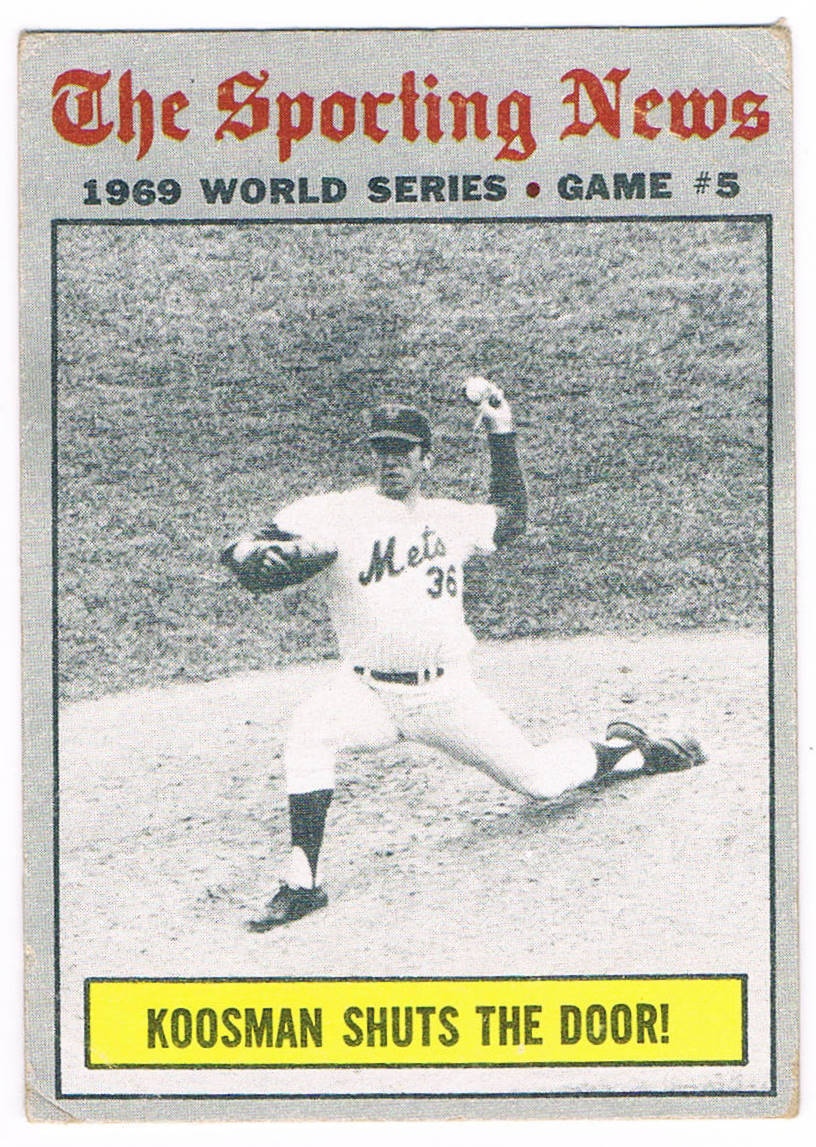
For the World Series subset, Topps used a format naming The Sporting News, much like the one they used in the 1969 set.

1970 Topps #309 -- Koosman Shuts the Door!

There were two legendary World Championships in 1969. Both featured heavily-favored teams from Baltimore and upstart teams from New York. Both ended with the young new York-based teams walking away with their rings. In January, it was Joe Namath and his Jets winning Super Bowl III; in October, it was the "Miracle Mets."  Since the long-standing "establishment" New York teams (the Yankees and Giants) had gone into decline mid-decade, the Jets and Mets gave New York fans reasons to be proud.

The picture on this card is from the deciding game of that series. Though the game is best remembered for the incident involving Gil Hodges showing a shoe polish scuff on a ball to get Cleon Jones awarded first base, Koosman's composure on the mound after getting into a 3-0 hole early in the game and going on to finish the game without giving up any more runs is significant.

As a result of winning teh World Series, the Mest were given the honor of appearing on Card #1 in the 1970 Topps set:

 1970 Topps #1 -- World Champions

For the 1971 Topps set, the playoff and World Series cards were featured in different subsets again. Each game was given its own card, with an additional Series "celebration" card, as was the case every year since 1960.

In 1970, the Orioles again took the A.L East flag, and they once again went against the Minnesota Twins in the ALCS.

1971 Topps #196 -- McNally Makes it Two Straight!

Once again, the result was the same. The O's swept the Twins in three games. The only difference was that they didn't have any games go into extra innings this time. All three games were won pretty handily. The card shows a Dave McNally pitch during Game 2, but the angle shows Brooks Robinson standing at third as well.

Over in the National League, two different team would vie for the right to play against the Orioles:

1971 Topps #201 -- Cline Scores Winning Run!

This time, the Pittsburgh Pirates and Cincinnati Reds took the field. The Reds ended up sweeping the Series, with the shot above of Ty Cline scoring the winning run in the eighth inning of Game 3.


In the World Series, two teams led by future Hall of Fame managers (Earl Weaver and Sparky Anderson) and balanced with stars and solid performers squared off. For the World Series subset, Topps used color photos, after using black-and-white ones in the playoff series:

 1971 Topps #327 - Powell Homers to Opposite Field!

The picture above mentions Boog Powell's home run. He clubbed one deep into the left field bleachers, which still had the Orioles behind 3-2. Brooks Robinson ended up putting the team ahead with a solo home run later in the game. He also proved his defensive value in this Series, getting the MVP and being featured in replay footage for the past 40 years.

Baltimore won the Series in 5 games, easing the sting of the previous year and getting the chance to show up on card #1 in the 1971 Topps set:

1971 Topps #1 -- World Champions

For the 1972 set, Topps did things a little differently. This time, all the pictures were in color. However, the League Championship Series were represented on only one card apiece and all the cards were part of a single series running between cards #221 and 230.

1972 Topps card #222 -- Orioles Champs!

For the third straight year, the Baltimore Orioles swept the ALCS in 3 games, this time against the Oakland A's. the shot above is from Game 2 of the series, with Mark Belanger congratulating Brooks Robinson for a home run.

1972 Topps #221 -- Bucs Champs!

The 1971 NLCS was the first playoff series that didn't end up being a sweep. The Pirates won, but not before the San Francisco Giants took one game. The shot above shows third baseman Jackie Hernandez grabbing a pop fly, as Willie Stargell comes in from left field to back him up.

Stargell was one of three Hall of Famers on the Pittsburgh Pirates that year. The other two were Bill Mazeroski and the man shown in the Game 4 card blow, Roberto Clemente:

1972 Topps #226 -- '71 World Series, Game 4

On paper, the Orioles were the better team. They were the defending champions and boasted four 20-game winners in their rotation. However, paper doesn't win 4 games. The series went to 7 games, and the the Pirates pulled out with the victory.

They're featured on card #1 in the 1972 Topps set:

1972 Topps #1 -- World Champions

That would be the final year of Topps giving their #1 card to the World Series winner.

Monday, October 11, 2010

To "Coin" a Phrase...

Once Topps bought Bowman and had the baseball card market to themselves, they began looking at new collecting avenues to explore. Beginning with contest and ad cards in 1957, they began inserting non-card items into their packs in 1960, just as Fleer began offering their own baseball and football cards.

In 1964, the inserted items were metal coins with player pictures on them. At first, there were 120 coins that looked like this:

The coins were basically round metal pieces with a player photo stamped on them. A small white banner below the player's picture contains his name, team and position. The backs were fairly basic, with a few lines of text and a notation that they were part of 120 total coins:


The coins were inserted one per five-cent wax pack. However, the packs themselves didn't mention anything about a coin being inside it:


(Image from an eBay auction)

However, the ten-cent cello packs not only mention that there are coins inside, but you can even see their outline on the wrapper:


(This also comes from an eBay auction)

The coins were also included in the 25-cent multi-packs sold through grocery stores. The six packs joined together in cellophane yielded six coins. These packs are shown in this sales sheet from 1964:

(Thanks to John Moran for sharing this great archive piece)

After the 1964 All-Star game, another series of coins made their way into later-series Topps wax packs. Twenty-two coins were made of players from each league, giving the 1964 Topps Coins set complete at 164 coins. In a gimmick, Mickey Mantle's All-Star coin showed the famous switch-hitter batting either right or left.

Among the new series, another white banner has been added to the top saying "1964 All-Stars," with only the player's name in the lower banner. The American League players were given a blue metallic background:

While National League players were given an orange color:

All-Star backs were changed to indicate that there were 44 new coins. The coins were numbered 121-164.


The next "minting" of Topps coins came in 1971. They were inserted into packs again, which were given a graphic down at the bottom of the pack. They must have still been in the planning stage when the wrappers were designed, as the coins are merely called inserts:


This time there were 153 coins, and the most recognizable feature is the band around the player's picture that contains the same info that had been in the small white banner back in 1964. The main difference is that the bands came in two colors:


National League players were given a green strip.

American Leaguers were given a red stripe.

As for the backs, they were so similar to the 1964 coins it might make collectors wonder whether the same people were assigned to produce them or whether they were too lazy to do anything different.


In addition to being inserted in packs of 1971, the coins even had their own checklist card included in the regular set:

1971 Topps Card #161 -- Coins Checklist

Since they were included with wax packages they aren't difficult to complete, nor are they all that hard to locate. However, as oddball items, the coins are usually passed over by card collectors, which keeps their value fairly low.

In fact, the coins and checklist card shown above aren't mine but from my 12 year-old daughter's collection and she's actually done well on the collection as far as what she's paid (being adorable probably helps that). What began as an attempt by hobby sellers Wayne Johnson and J.D. Heckathorn to get her hooked on the hobby (J.D. gave her nearly half the set, asking only for a smile in return, at the 2009 National to "get her started"), she's actually less than 20 coins away from completing the '71 set and is hoping to finish it up soon (If you'd like to help her, her wantlist is included in mine...just scroll down to 1971). She's also interested in finishing the '64 set eventually and may even get started on the separate coin sets Topps issued between 1988-'90.

Wednesday, June 23, 2010

What the...

Sometimes, you see a card that just doesn't look right. While sometimes the problems can be attributed to the games that youngsters have played with their cards or on torture lovingly inflicted by their previous owners, sometimes the blame needs to be placed on the card maker itself. Take this card from 1971 Topps:
In the case of this Luis Tiant card, there are a lot of things going on here. It's miscut, identifies another player entirely, exhibits a little of the border chipping that really frustrates collectors of the 1971 Topps set and is diamond-cut to boot. It looks like the printing sheet was loaded into the cutter upside down, creating unique versions of this Tiant card and the other 131 cards joining him. Undetected by Topps' QA inspectors, the card was placed in a wax wrapper and sent out for a collector to pull out and say, "Aargh!"

While some collectors see this card as absolutely useless (the card number on the back is Osteen's), I say it shows that even a machine designed for high-efficiency mass production will get it wrong sometime.