Showing posts with label 1972 Topps. Show all posts

Friday, September 7, 2012

More "New" (But Old) Additions

Though I'm using this blog to spread information about sets and vintage cards, I'm still a collector. So from time to time I get to feature some "new" additions to my collection, such as these recent arrivals:

1965 Topps #399 -- Ray Herbert, Philadelphia Philles

For some reason, I've let many of the early 1960s Topps sets fall under the radar in my collection. It's not for any specific reason...In the long run, I'm more focused on 1950s material, while 1970s sets are more complete due to that being when I began collecting myself. However, those longer 1961-'65 wantlists make a tempting target for anybody who has the cards in their dupes boxes.

Ray Herbert had been playing in the majors since before Topps printed cards. He debuted in 1950 but missed a few years in the meantime: 1952 was spent in another uniform, as Uncle Sam drafted him during the Korean War, while he spent 1956 and '57 back in the minors before coming back up for the rest of his career. In 1965, he began with his fourth and final major league club (this is an airbrushed card which shows him as a member of the White Sox).


1965 Topps #455 -- Norm Siebern, Baltimore Orioles

Norm Siebern was even more well-traveled, appearing on six different major league teams in 12 years. Starting with the Yankees in the late 1950s, he was one of the players dealt to the A's for Roger Maris. He went to Baltimore before the 1964 season in a trade for Jim Gentile. His time there ended after the 1965 season, as he was dealt to California. After a year there, he went through short stints with San Francisco and Boston before retiring in 1968.


1965 Topps #503 -- Phil Gagliano, St. Louis Cardinals

1965 was the most productive year of Phil Gagliano's career, seeing him get into 122 games. He was a Memphis native (in fact, he and teammate Tim McCarver played together in high school) and earned two World Series rings before he was sent to the Cubs and them the Red Sox in 1970. He closed out his career with a stint with the Reds from 1973-74. Late in his career, Gagliano became a rather effective pinch-hitting specialist, hitting over .350 in that position for both of his last two teams.


1965 Topps #525 -- Eddie Bressoud, Boston Red Sox

Eddie Bressoud came up in 1956 with the New York Giants and moved with them to San Fancisco, In 1961, he went to the Red Sox and stayed there through 1965. Stints with the Mets in 1966 and the Cardinals the next year represented two very different levels of play, and he closed his career out with two games as a defensive replacement in the 1967 World Series. His name invited a nickname of "Steady Eddie" and his period as the regular shortstop for both the Giants and Red Sox might have invited the tag. He was a prototypical good field/no hit shortstop who never hit over .300 but usually hit over .250.  

There were also a couple of hits to the 1972 Topps set in the package. That set is special
to me since it's my birthyear set. However, the remaining cards I need are from the tough semi-hi series or the even tougher hi series. That makes every card added a real treat. So these two are awesome:

1972 Topps #651 -- John Strohmayer, Montreal Expos

Here's a player who's featured in my other blog (1973 Topps Photography) today. I really didn't plan that little bit of synergy, but will take any opportunity to give a plug to my other card-related pursuit.
There's not a lot of info about John Strohmayer, but here's an interesting bit: after retiring, he started a second career as an educator in California and spent 32 years shaping the minds of his students as a teacher, principal and superintendent. As he was set to retire, he and his co-workers hit the jackpot in the lottery. That's a pretty nice way to go out.

1972 Topps #751 -- Steve Carlton, Philadelphia Phillies

I was absolutlely floored when this one came out of the package. Not only is "Lefty" a Hall of Famer and one of the last significant cards needed in the set, 1972 was one of those "once in a lifetime" seasons that a select group of pitchers have. While winning 27 games was definitely a huge accomplishment, Carlton did it for a team that won only 59 for the entire year.

That was a really big hit to a set with fewer big "hits" left.

Wednesday, March 21, 2012

Double Duty/Triple Cards

As many of you know, I write two card-related blogs. In addition to this one, I write a card-by-card excursion through the 1973 Topps set and the sometimes interesting choice of pictures used on the fronts. Called 1973 Topps Photography, bad action shots, airbrushed players and 1970s fashion get their due.

If you're also a regular reader of that blog, thank you. If you're not...then feel free to take a look. I'm still a little less than halfway through the issue and there's plenty more to share.

My post over there today features a multi-player rookie card. Those weren't new in 1973...Topps had included them in every one of their base sets since 1962. In the case of the card shown today, one of the player's wasn't even a true rookie, as he appeared on two other cards before that.

However, in this case, the 1973 card was actually the "normal" one in the group. That is the oddity here.

The player in question is Bob Reynolds. His first card was part of the final series of the 1971 Topps set:  

1971 Topps #661 -- Rookie Pitchers

This card featured three pitchers, all from different teams. Since Topps kept these rookie cards sorted by team (and showing two players, not three) in the earlier series, they were likely trying to wrap up their loose ends late in the production cycle to get the set finished. In those cases, they'd group the players by position and even by league.

In this case, they lumped three players together who all had the same last name.

Reynold's 1972 card was memorable for a different reason:

1972 Topps #161 -- Brewers Rookie Stars

Topps stayed with the three-player format for 1972's multi-player rookie cards, and this one had a fairly noticeable error. The pictures of Darrell Porter and Jerry Bell are switched, so Bob Reynolds is the only player on the card who's properly credited.

For the third multi-player rookie card showing Bob Reynolds, Topps decided he had had enough excitement:

1973 Topps #612 -- Rookie Pitchers

Other than Brent Strom being in an obviously airbrushed uniform...there were no hijinks this time.

Monday, March 19, 2012

In Action Cards - Series 4.1

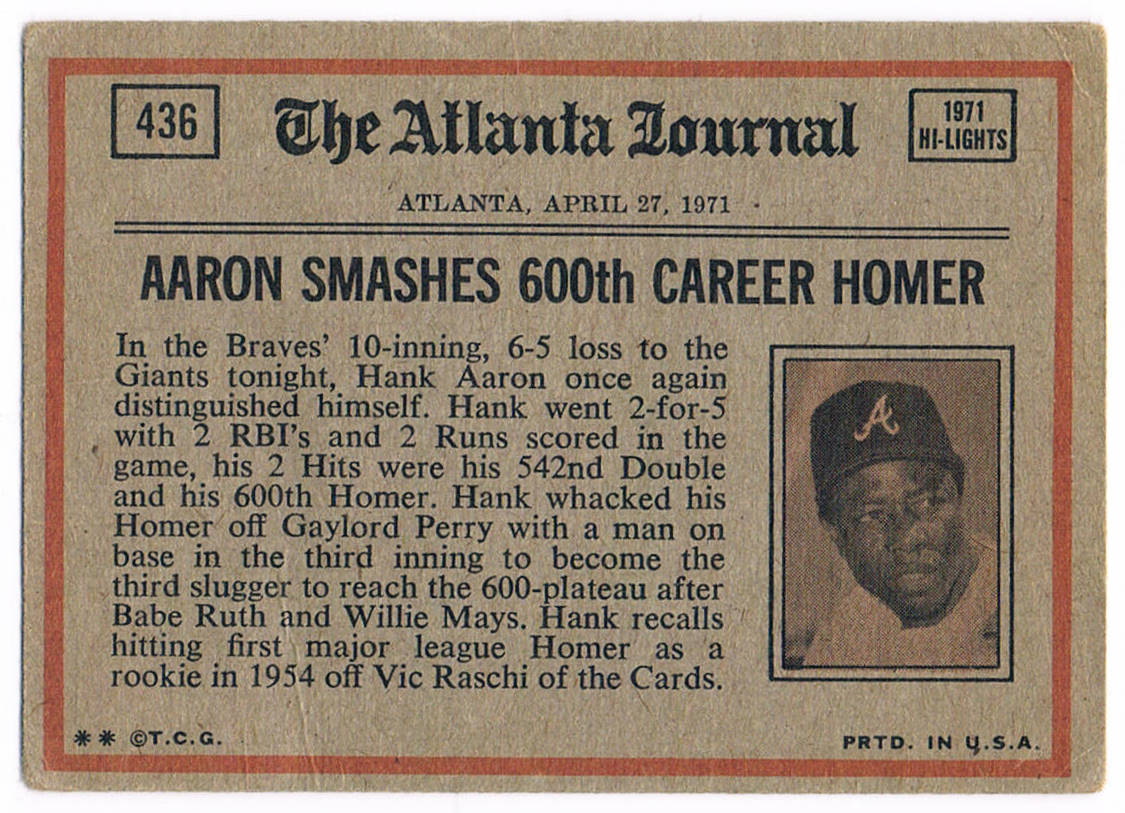
This time around, I'll continue looking at the backs of the various "In Action" cards that were included in the 1972 Topps set. The last time around, I showed 6 of the 11 different "newspaper story" accounts of 1971 highlights. Here are the rest:


Friday, March 2, 2012

Names, Tags, Labels and Slang

My last blog entry featured a link to this page of hobby-related slang used by members of OBC, a group of "old school" style collectors that happens to include me. That list includes several "names" given to refer to certain sets.

For example:


1955 Bowman is referred to as the "TV set" for obvious reasons.


 "Horizontals" refer to 1960 Topps, although I argue that 1955 and '56 Topps should also have that name. Especially when you consider that not all '60 Topps cards are horizontal.


1962 Topps are called "Woodies." I suppose the label could also apply to 1987 Topps, but OBC officially stops paying attention in 1980. I didn't say that was right...it's just the way they do things.


"Burlap" refers to the outer edges that appear on 1968 Topps cards.


"Cool Gray" is a nickname for the 1970 Topps set, whose design has been mentioned as one that has aged a lot better than many expected.


 1971 Topps are called "Black Beauties," a name that is quite apt.

 "Psycho" is the name given to the 1972 Topps set, both as a result of its design and that little issue of the higher-numbered cards that keep many from completing it for an awful long time. Not that I'm bitter about it or anything...


And then there's the term "jiggler," which is said to refer to the 1962 and '63 Jell-O sets even though the term is rarely used. In fact, I don't recall ever hearing it used in any type of conversation.

Of course, OBC isn't alone when it comes to giving names to various sets. Right here in the Blogosphere, Night Owl is keeping a list of "define the Design" nicknames for several sets, both within and beyond the scope of what OBC deems its "window." There's one thing for certain...we collectors definitely use slang and jargon, which we can use to identify each other in our own unique geekiness.

Wednesday, February 29, 2012

Leap Day Psychedelic Treat

Today is Leap Day, which only occurs once every four years. In honor of that, here's an awesome card that was shared with me from a fellow collector named Steve that shows a really distorted image of a true original:


1972 Topps #179 -- Dock Ellis, Pittsburgh Pirates

While cards that feature out-of-register photos are generally viewed unfavorably by collectors, the fact that it is on a 1972 Topps card (which are lovingly called "Psychos" by my friends over at OBC) makes it look like you need a special pair of 3-D glasses to look at it.

Additionally, it's appropriate that the card pictures Dock Ellis, a pitcher who is notoriously best-known today for tossing a no-hitter in 1970 while he was under the influence of a hallucinogenic. Here's the story in Dock's own words:


That video never fails to make me laugh. The guitar lick you hear in it, by the way, is from the 1970/71 song "(Do the) Push & Pull (Part 1)" by Rufus Thomas. It adds with the artwork and the audio effects to give it a humorous vibe.

(As a public service announcement, I need to point out that drugs aren't a laughing matter, and neither is the abuse of them. But the description Ellis gives of the effects he experienced on the field that day are just priceless. That said...kids, don't try that.)

Monday, February 6, 2012

In Action Cards - Series 4

Today, I'll continue the series I've been doing here where I'm showing the backs of the "In Action" cards from the 1972 Topps set.

That set was split into six series through the year, with each having a subset of 24 cards that had a player and then a special "action" card of the same player. So far, I've shared the following series:

Series 1
Series 2
Series 3

In series 4, the 12 cards included one (also shown in each of the previous series) that previewed the puzzles that would be included in the next two series. The other 11 recapped highlights from 1971, under the logo of the home city of the player who is being honored. I'll show six of them today and save the rest for later.


Monday, January 2, 2012

In Action Cards - Series 3

This is a continuation of a series on this blog that shows what was on the backs of the 1972 Topps "In Action" cards. As with all series, there were 12 cards in Series 3 that were part of a 24-card subset that was seeded base/action. Two of the cards repeated the previews of upcoming series: one was for Series 3/4 and the other was for Series 5/6. The other ten were a new feature to baseball cards.

They use a game situation, using the names of actual players, and ask the owner to determine what the result would be, according to the rules (and assuming that the umpire actually makes the call according to "The Book."). It's a feature that was adapted from a regular column in Baseball Digest but apparently wasn't popular, since it never appeared again in a Topps base set.

Reading through them, I got some right and some wrong, just as I did when I was a regular reader of the magazine. Here they all are; see how good you can do (right-click if the letters are too small):


Friday, December 23, 2011

Cards Inside Other Cards

Christmas is on Sunday, and since this is the the last scheduled post before the Holiday, here's a card I recently had sent to me from a fellow collector from Indiana named Randy:

It's not the best looking card in my 1972 set, but it fills one more hole in my binder. The '72 set is my birthyear set, so every step closer I get is a positive one.

Wilson is part of the semi-hi numbers, the fifth series of six in the set. The semi his are fairly tough (unless you want to shell out the money to buy them) and the hi numbers are even tougher. I still have about 115 cards to go on the set (making it the only set I'm working on since 1967 that has a wantlist over 100 cards).

The reason I'm showing it here today is because it came inside a different type of card...one that looks like this:


Nothing like vintage cardboard to spread the Holiday cheer around.

Merry Christmas! May all your stockings be filled with cards and wax packs.

Wednesday, December 21, 2011

In Action Cards - Series 2

Last week, I showed the backs of the "In Action" cards from the first series of 1972 Topps. In the second series, there were also 12 "In Action" cards, with six of them repeating backs that showed the features planned for series 3 through 6. The other six cards looked at the past:


Two of the cards showed the batting leaders through the seasons, one for the American League (above) and another for the National League:


It's a shame there wasn't enough space to fit the averages on the card, though. That would have been interesting to see how batting .400 was fairly common in the first few decades of the 20th century, especially considering the lower averages in the late 1960s.

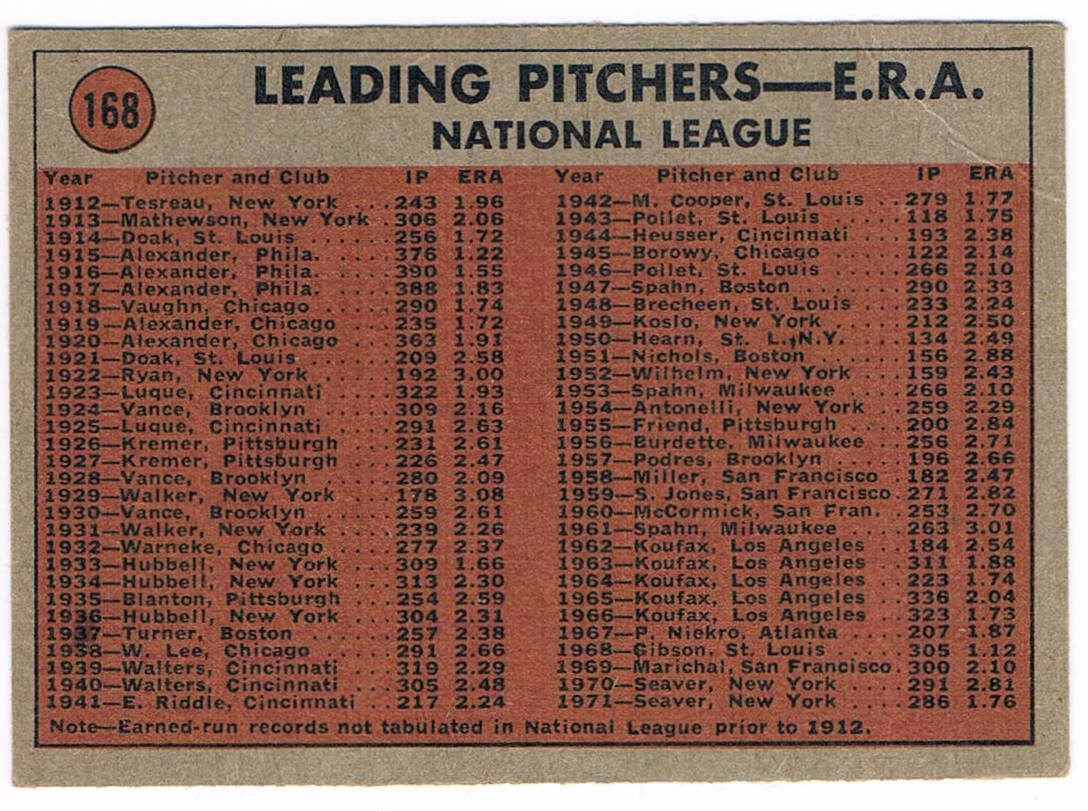
Two of the cards featured the top pitchers, based on their ERAs, and this time the numbers are included:


Once again, the American League leaders are above and the National Leaguers are below:


The stats omitted results prior to 1913, but those have since been tabulated by baseball historians and can be found on Baseball-Reference's site. What's interesting is that in 1971, the leading pitcher's ERA was under 2 in both leagues. That was accomplished again in 1972, but never again.

Finally, there were two cards that showed the pennant winners:

As you might expect, the New York Yankees are named frequently. However, it's worth pointing out that during the league's first two decades, Boston and Philadelphia were the stalwarts (with Detroit and Chicago getting the rest of the pennants).


Here's something you may not have known: Brooklyn won the National League pennant (and the World Championship, by default) in 1900. They also won it in 1899, but that isn't shown on this card. So, 1955 really wasn't their first time with a title...but it was before the American League appeared, so for whatever reason, it isn't considered to be "legitimate." If I were a Brooklyn fan, I'd argue that it definitely was.

Monday, December 12, 2011

Coming Attractions

Last Friday, I showed off an "In Action" card from the 1972 Topps set and threatened to feature the backs in an upcoming blog entry. Well, there's no time like the present to get started on a project...

As I said last time, there were six different series of cards issued by Topps in 1972 and each one consisted of a 24-card subset that had a player's base card followed by an "action" card. Many showed game-action shots, but several featured odd pictures like this one:


This definitely isn't a game-action shot. "Tom Terrific" looks to be responding to somebody walking up to the plate with a bat placed between his legs to signify how large his "Schwartz" is.

One manager even got an "action" card. Appropriately enough, it was "Billy the Kid," explaining his position with an umpire:


Truth be told, I would have liked to see him kicking dirt on the umpire's shoe. I also would have liked to see Earl Weaver get a card as well.

The backs of the "In Action" cards featured highlights as well. In series 1, all 12 of the cards served as previews of features in the upcoming series.


The league leaders were part of series one, on cards 85-96. Each league was represented by its '71 leaders in six separate offensive or pitching categories. Series two featured a recap of the postseason on cards 221-230. There were single cards for each LCS, a card for each of the 1971 World Series games and a recap card celebrating the Pirates' win. I featured them in this entry a year ago. Interestingly, the postseason preview shows a card of a Yankees player; the Yanks hadn't been in the postseason since 1964.


For series three and four, the subsets teased eventually ended up on the backs of the "In Action" cards. Ten cards in series three featured game situations, as well as the "answer" according to the rules of the game. For series four, eleven cards recapped highlights of the 1971 season. These will be shown in detail in a later entry to this blog.


The top mentions childhood photos of star players, which appeared in both series three (cards 341-348) and four (cards 491-498).


Series five and six each show two subsets. Series five teases a subset featuring the winners of several awards, but cards 621-626 ended up showing pictures of the awards themselves. It might be likely that the original plan called for the cards to feature players but weren't ready when the series needed to be printed up. The puzzles of Joe Torre and Carl Yastrzemski were on the backs of the "In Action" cards; each player had six pieces.

The "traded" cards in series six appeared on cards 751-757 and featured Steve Carlton, Joe Morgan, Frank Robinson, Denny McClain, Jim Fregosi, Rick Wise and Jose Cardenal. Interestingly, the series didn't include the player who was traded away for Fregosi: Nolan Ryan. Once again, the puzzle pieces of Tony Oliva and Tom Seaver were on the backs of the "In Action" cards, with each player getting six pieces.