Friday, August 31, 2012

Post #400

(Today, this blog passes 400 posts. Not bad for a pursuit I'd be afraid might run out of gas by now. But, as long as I keep getting inspiration, I'll keep showing up and posting.)

Today's post shows a couple of cards I recently received from a trading buddy:


One of the things that really makes the 1956 Topps set stand out for me is the way it used an additional action photo along with the head shot. And the action shots were sometimes interesting: a player is shown running the bases, or grabbing a fly ball, and a lot are shown in plays at the plate. Since Lou Berberet was a catcher, he was a natural for a play at the plate. However, the Topps artist appears to have cropped out the runner...so he looks to be showing a dance move to the umpire.


And now for the other card in that package...a "Wow" if there ever was one:


This picture is almost a commercial. If you told most people that RC Cola was a sponsor of Nolan Ryan's 1971 Topps card, there'd be little argument. I know it was a sign at Shea Stadium at the time, but Ryan's positioned so well in the shot (and we are so predisposed to seeing commercialism anyways) that it just looks a little too nice.

As for the card? Yes, it's off-centered to the point of being considered a miscut. And yes, there's a crease that runs right through the middle that extends to the back of the card. But if you've bothered to pay attention to this blog, you know that I don't care about that stuff as much as others do. The card was the right price -- free -- and the sender figured it would have a better place in my own collection than it would in his dupes box.

And he'd be right. It's a great addition.

Wednesday, August 29, 2012

Hey...There's Some Residue Here...

Here's a card I picked up at the National. Actually, it's an intact panel:


While it looks like a 1977 Hostess, there is a slight difference on the back:


The black strip shows that it's a 1977 Hostess Twinkie card. Both the Hostess set and the Twinkie set have the same 150 cards. However, the Hostess set was distributed in 3-card panels of various types of snack cakes, and the Twinkie set was distributed in single panels. Despite the name, the cards were found in packages of Twinkies and Hostess Cupcakes as well.

This one was distributed with Twinkies. How do I know for sure? Those stains on the card offer pretty convincing proof.

Monday, August 27, 2012

More National "Type" Cards

When I went to the National earlier this month, I picked up some items with future blog posts in mind, and also to add some interesting items to my collection. These items fit both of those criteria.

I've mentioned here before that I have some interest in vintage Japanese cards. While in Baltimore, I picked up a few type cards to add to the collection, all are from the 1948-'50 time period and all are different types of Menko cards. 

This is a die-cut Menko from the JDM 14 set. They are distinguished by a bat/ball/glove at the top on the reverse. It features Tamotau Uchimori, which I figured out simply by the uniform number...I am still not able to read the characters on the card. There are 12 cards in the complete set, and this is one of the commons.

With 11 cards to go here, I might be interested in going after the other 11. Maybe.


This card is a rectangular Menko. The cards were designed with a number of games for kids to play. While there was the "card-flipping" aspect familiar to American collectors of the era, Menkos also featured other games, such as the rock/paper/scissors game represented in the fist on the reverse. This is one of the cards in the JDM 119 set, also known as Maruman cards from 1950 (Maruman is a company; their logo appears on the reverse next to the player's cheek). From what I understand, the league designation -- Central League or Pacific League -- runs along the top and the player's name appears in the circle. The name on the back is obscured by a number, which lets me identify it. This is Shissho Takasue.


Now, I'm still trying to determine this one. It's a round Menko and is thicker than the others, presumably so it can be thrown down by its owner in a game. According to my reference book, this design should be a JRM 17 except for two major things: the borders should be red and there is no "533-71" card listed in that set.

If you know, chime in in the comments. This one is beginning to get under my usually thick skin.

Friday, August 24, 2012

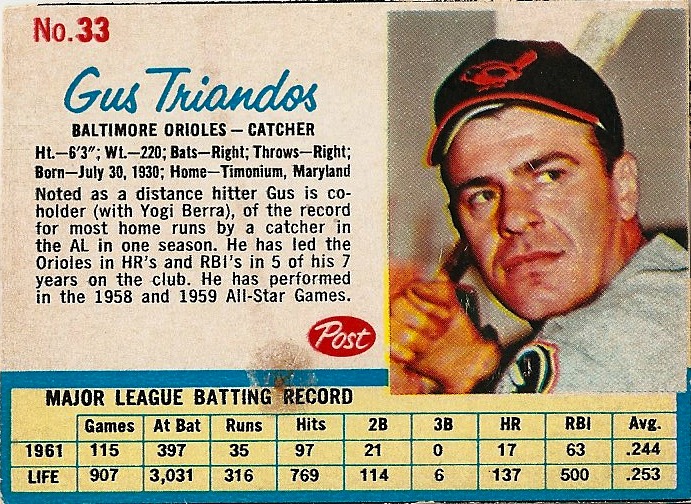
Q&A -- Gus Triandos Card

Today's question comes to me through my position in OBC as the "card identification guy":

Q:

"I have a Gus Triandos card with plain cardboard back done by Post the year is 1961. I have never seen a card like this. Do you have any info on this card?"


(There was no scan with the email, so I cribbed this image from the Orioles Card "O" the Day blog. Hope that's OK, Kevin.)


A:

Post cereal placed cards on the backs of various cereal boxes in the early 1960s. If your year shown on the card is 1961, then it's the 1962 Post set that your Triandos card is from. He is featured on card #33 in that set, and #69 in the '61 set. Here's a link to an explanation of the set, as well as a neat TV commercial about them.


Here's the link to the other Post set checklists, if you've never seen this type of card before.

Wednesday, August 22, 2012

These Have Kept Better Than the Dairy Products

Here's an issue that many don't get to see that often:


This is from a 1933 issue called Butter Creams. It's a 30-card issue that is identifiable by the relatively thin size (1 1/4" by 3 1/2", or the size of a modern card cut in half) as well as the text on the back:


There are actually two backs for these cards. This was the second variation, which has an Oct. 1st date and includes the address of the company on it. There may have been some confusion that necessitated this change, as the original -- dated Sept. 1 -- failed to include the address. The contest was to have fans estimate the statistics of the player on the front by the listed date.

Monday, August 20, 2012

More 1969 Issues...The Old Teams

I was mentioning earlier about how Topps handled the four expansion teams in 1969, but they had some issues with some of the other teams, as well. One had moved, while the other was problematic for a few years.

The first team was the Oakland A's. 1968 was the first year they played in Kansas City, but due to the ongoing issue that Topps was having with the players' union, many of the cards still showed them in 1967, which meant that the "KC" logo was still on their hats and needed to be airbrushed.

Here's an example of a hat that was altered, even when a coach in the background didn't get the same treatment:

Card #217 -- John Donaldson, Oakland A's

The hats were either given a black block or had green to cover the newer insignia with an "A" on it. This one shows the "ghost" of that logo:

Card #68 -- Dave Duncan, Oakland A's

However, by the end of the year, the legal issues with the union were resolved and the logo was used on the cards for all to see:
Card #655 -- Mike Hershberger, Oakland A's

This issue presented itself on the leaders card as well, as Danny Cater has a picture showing him in an obvious White Sox uniform even though he'd been with the A's since 1966:

Card #1 -- American League Batting Leaders

Other teams were bothered as well. Here's Ken Harrelson, listed as a Red Sox player but clearly wearing a Washington Senators uniform:

Card #5 -- American League Home Run Leaders

Now for the team that had been presenting Topps with problems...the Houston Astros. Originally called the Colt .45s, they were simply called the Colts on their early cards. When they changed the team name to Astros before the '65 season, Topps referred to the team as simply "Houston" in the early series and changing things up later; they were called Astros but all the cap were airbrushed, except for the one rookie card. In '66 and '67, there seems to have been some trouble with the name, as they were once again called "Houston."

In 1968 and '69, the team was still referred to as "Houston" but all the traces of the cap logo were eliminated from the photos. The blogs 1968 Topps and The Fleer Sticker Project delve a little deeper here.

So this was continued in 1969:
Card #76 -- Norm Miller, Houston Astros

The logo returned late in the season, but the name "Astros" would have to wait until 1970 before it was back for good:

Card #656 -- Dan Schneider, Houston Astros

By the time the 1969 season came to a close, things returned to normal...Topps was back to making its own mistakes on cards, such as using a picture of a 14-year old batboy of the card of a legitimate major leaguer:


Card #653 -- "Aurelio Rodriguez," California Angels

And only blacking out the logos of traded players:

Card #565 -- Hoyt Wilhelm, California Angels

Friday, August 17, 2012

Adding To the Stack...1954 Bowman

Now that I have a scanner, let me resurrect a feature I really enjoyed...commenting on the careers of players whose cards I recently picked up...this time from the 1954 Bowman set:

Card #2 -- Jackie Jensen, Boston Red Sox

Somebody was nice enough to pencil in "Pitcher" at the top of the card, which was somewhat wrong...Jackie Jensen was an outfielder, even though he did pitch in college. However, the 1954 date scribbled in at the bottom was correct.

Jensen benefited from the GI Bill. After serving in the Navy during World War II, he went to the University of California and earned All-American recognition in two sports there. Not only was he a standout baseball player who helped Cal win the first College World Series, but he was a star halfback on the team that played in the 1949 Rose Bowl. After his junior year, he left college to play baseball.

In 1954, he was just beginning with the Red Sox. He had been with the Yankees, where he was expected to replace Joe DiMaggio in center field until the arrival of Mickey Mantle changed the team's plans, and then the Senators, who didn't have another "big name" to help. Boston had Ted Williams, so that wasn't an issue. He thrived in Boston and won the 1958 MVP award. However, his aversion to flying made him walk away from the game while he was still at his peak.
  
Card #60 -- Fred Baczewksi, Cincinnati Reds

The same previous owner who penciled in "Pitcher" did so here as well. This time, Fred Baczewski was a hurler. In fact, when this card came out the southpaw had just completed a terrific rookie campaign, where he went 11-4 after a midseason trade with the Cubs. However, he was unable to sustain that success and was back in the minors by 1955.


Card #156 -- Rocky Bridges, Cincinnati Reds

The card here says Everett Lamar Bridges, but everybody knew him as Rocky. And that was an apt nickname. His 1959 Topps card appeared in a book called The Great American Baseball Card Flipping, Trading and Bubble Gum Book. I'll let that book's authors Brendan Boyd and Fred Harris speak about him:

"Rocky Bridges looked like a ballplayer. In fact, he probably looked more like a ballplayer than any ballplayer who ever lived. His head looked like a sack of rusty nails, he kept about six inches of tobacco lodged permanently in the upper recesses of his left cheek, and his uniform always looked as if he had just slept in it...(he) could have intimidated Ty Cobb. He was the sort of guy who would spike his own grandmother to break up a double play.
Their book is available at Amazon, just click the link below. If you've never read the book, check it out. You'll be glad you did.


With a reputation like that, you'd think that he'd have died tragically. However, Rocky Bridges is still around today...in fact, he's the only person in this post who didn't pass away relatively young.

Back to my post for one final card:

Card #191 -- Karl Drews, Philadelphia Phillies

Karl Drews spent a long time in the game. Signed at the age of 18 before the 1939 season, he worked his way through the minors (except 1943, when he wasn't playing at all) and finally broke into the big leagues with the Yankees in 1946. He would be demoted back to the minors in 1950 after going to the St. Louis Browns, but fought his way back. 1954 would be his last season in the majors, but he kept pitching. In 1960, he was pitching in Mexico before hanging up the glove at the age of 40.

After all that fighting, Drews was killed in 1963 after his car broke down in Florida. While getting help, he was hit by a drunk driver.