Showing posts with label 1954 Bowman. Show all posts

Friday, August 17, 2012

Adding To the Stack...1954 Bowman

Now that I have a scanner, let me resurrect a feature I really enjoyed...commenting on the careers of players whose cards I recently picked up...this time from the 1954 Bowman set:

Card #2 -- Jackie Jensen, Boston Red Sox

Somebody was nice enough to pencil in "Pitcher" at the top of the card, which was somewhat wrong...Jackie Jensen was an outfielder, even though he did pitch in college. However, the 1954 date scribbled in at the bottom was correct.

Jensen benefited from the GI Bill. After serving in the Navy during World War II, he went to the University of California and earned All-American recognition in two sports there. Not only was he a standout baseball player who helped Cal win the first College World Series, but he was a star halfback on the team that played in the 1949 Rose Bowl. After his junior year, he left college to play baseball.

In 1954, he was just beginning with the Red Sox. He had been with the Yankees, where he was expected to replace Joe DiMaggio in center field until the arrival of Mickey Mantle changed the team's plans, and then the Senators, who didn't have another "big name" to help. Boston had Ted Williams, so that wasn't an issue. He thrived in Boston and won the 1958 MVP award. However, his aversion to flying made him walk away from the game while he was still at his peak.
  
Card #60 -- Fred Baczewksi, Cincinnati Reds

The same previous owner who penciled in "Pitcher" did so here as well. This time, Fred Baczewski was a hurler. In fact, when this card came out the southpaw had just completed a terrific rookie campaign, where he went 11-4 after a midseason trade with the Cubs. However, he was unable to sustain that success and was back in the minors by 1955.


Card #156 -- Rocky Bridges, Cincinnati Reds

The card here says Everett Lamar Bridges, but everybody knew him as Rocky. And that was an apt nickname. His 1959 Topps card appeared in a book called The Great American Baseball Card Flipping, Trading and Bubble Gum Book. I'll let that book's authors Brendan Boyd and Fred Harris speak about him:

"Rocky Bridges looked like a ballplayer. In fact, he probably looked more like a ballplayer than any ballplayer who ever lived. His head looked like a sack of rusty nails, he kept about six inches of tobacco lodged permanently in the upper recesses of his left cheek, and his uniform always looked as if he had just slept in it...(he) could have intimidated Ty Cobb. He was the sort of guy who would spike his own grandmother to break up a double play." 
Their book is available at Amazon, just click the link below. If you've never read the book, check it out. You'll be glad you did.


With a reputation like that, you'd think that he'd have died tragically. However, Rocky Bridges is still around today...in fact, he's the only person in this post who didn't pass away relatively young.

Back to my post for one final card:

Card #191 -- Karl Drews, Philadelphia Phillies

Karl Drews spent a long time in the game. Signed at the age of 18 before the 1939 season, he worked his way through the minors (except 1943, when he wasn't playing at all) and finally broke into the big leagues with the Yankees in 1946. He would be demoted back to the minors in 1950 after going to the St. Louis Browns, but fought his way back. 1954 would be his last season in the majors, but he kept pitching. In 1960, he was pitching in Mexico before hanging up the glove at the age of 40.

After all that fighting, Drews was killed in 1963 after his car broke down in Florida. While getting help, he was hit by a drunk driver.

Wednesday, August 8, 2012

Ballad of Another Forty Bucks

Last month, I featured the details of a deal that I recently completed and promptly had the most successful post on this blog in a long time. Well, here's hoping the iron strikes again...

The opportunity to make another "dealer scum" deal arose with the same trader (Ed Schott of Baltimore). For another forty dollars, Ed sent the following cards:

1961 Topps #200 -- Warren Spahn, Milwaukee Braves

 At first glance, this card looks really nice. However, the bottom edge is uneven, showing that it's been trimmed. The condition was made clear before the deal was made, which is important whenever money changes hands. As you can see, the condition presents well but little things like trimming need to be brought up ahead of time to head off future problems when (not if) they are discovered. As a seller, you really don't need to get a reputation because you don't notice details. Even if it isn't your fault.

I say that now, because the other card from 1961 is certainly trimmed:

1961 Topps #226 -- New York Yankees Team Card

There's no question this card was trimmed, as all four edges show uneven borders. However, this type of card makes some collectors a little squeamish. Personally, I'd rather have a hole in the card than one in the binder. I can always upgrade later.

Trimming is about the only thing that isn't apparent on the next card:

1958 Topps #351 -- Braves' Fence Busters

In 1961, three of these players -- Aaron, Mathews and Adcock -- would team with Frank Thomas (on the Pirates in 1957) to become the first tandem to belt four straight home runs, in a game against the Reds. The mark has been equaled six times since, but has never been broken. Topps was noting their power three years earlier.

Not only that, but it was a chance to add a card featuring two Hall of Famers into my 1958 Topps binder.

1954 Bowman #154 -- Don Newcombe, Brooklyn Dodgers

I also enjoy sliding another 1950s Brooklyn Dodger into the binder as well. And this one cuts my 1954 Bowman wantlist to 92 cards, but a quick count shows I still need 10 of the 14 Brooklyn Dodgers including Duke Snider, Pee Wee Reese and Roy Campanella.

Fortunately, I'm not a fan of the Bums (even though I respect their impact on the game). The fact is, I'm a fan of this guy's team:

1954 Topps #50 -- Yogi Berra, New York Yankees

The flip side to being a Yankees fan is that I really need to adjust my expectations about how much I spend on the cards of the players who wore pinstripes over the years. This card -- beat up as it is -- accounted for about half of my $40 purchase.

So I ask again: would you have made this purchase? Or would the trimmed cards have made you reconsider?

Wednesday, August 17, 2011

More 1954 Bowman Cards in the Mail

This brings to mind the question: should the plural of Bowman be Bowmen?

In any case, I've recently added two more 1954 Bowman cards to my collection...and my wantlist for that set has finally dropped to under 100 left.

While these cards feature players representing the teams that made the 1954 World Series, neither player managed to actually play any big league games at all that year:

Card #212 -- Owen Friend, Cleveland Indians

Owen Friend never managed to get out of the minors in 1954. Cleveland was the third of his five major league teams, and he was only with the Tribe for the second half of 1953. After failing to make the parent club, Cleveland sold him to the Red Sox after the '54 season. He played with the Sox as well as the Cubs in '55 before going back to the minors for good after '56.

A minor league skipper and major league scout after retiring, Friend passed away in 2007.

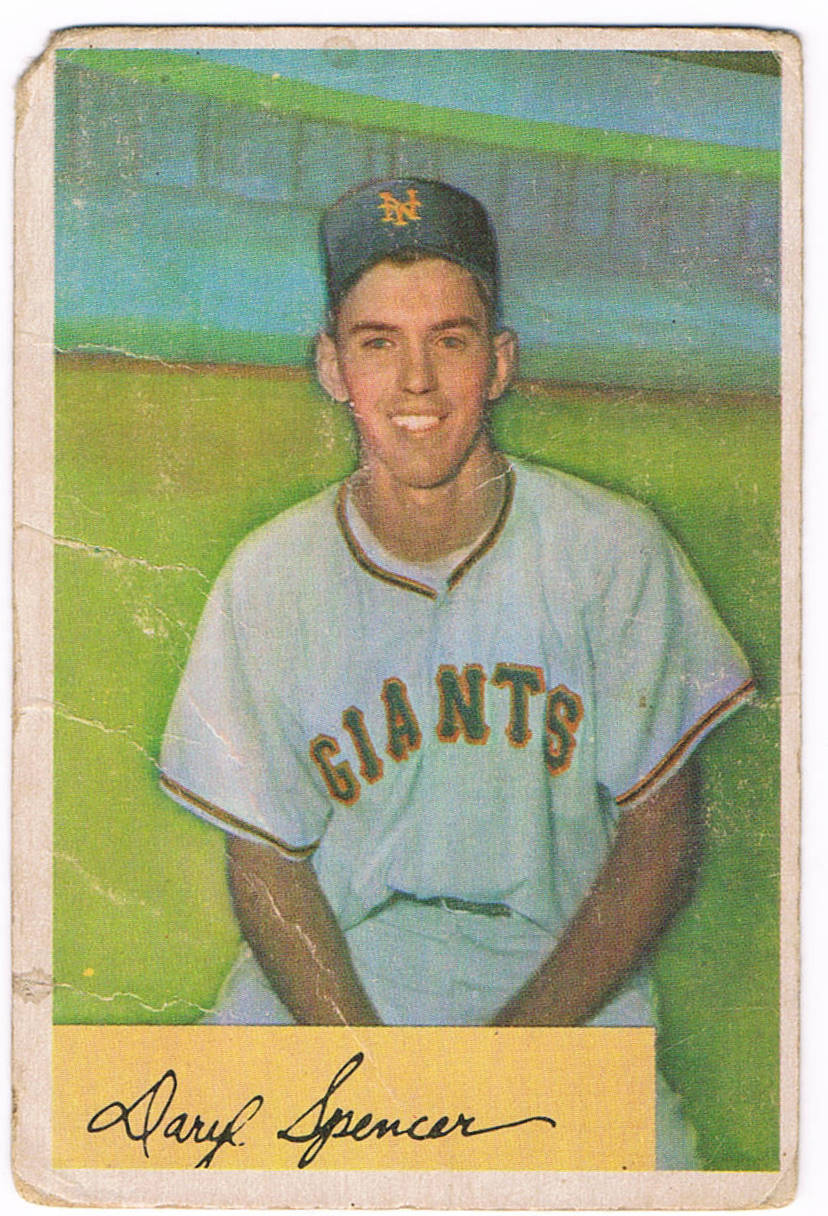
Card #185 -- Daryl Spencer, New York Giants

As for Daryl Spencer, 1954 saw him take a two-year sabbatical from baseball to wear an entirely different uniform. His Uncle Sam had other tasks for him.

A utility infielder as a major leaguer, Spencer was one of the first American players (rather, American players who weren't of Asian heritage) to make a career playing in Japan. After eleven seasons in the major leagues, he played several more for the Hankyu Braves before retiring in 1972.

Spencer is still alive today, and is a well-regarded signer for fans who send cards and letters to him.

Friday, July 8, 2011

Ending The Week With an Interesting Card

Since my other posts this week have involved 1954 Bowman cards, here's one that I have always found interesting:

Card #222 -- Memo Luna, St. Louis Cardinals

The name is awesome, the uniform is obviously airbrushed and the crease that runs through my card makes it even more unique (in my opinion). However, that's not the only interesting thing about this card...take a look at the back:

NO MAJOR LEAGUE RECORD!

Imagine being a kid in 1954 who pulled this one out of a gum pack. I'd have probably bent it in half too.

His real name was Guillermo Luna and he ended up appearing in only one major league game, on April 20, 1954. Luna didn't make it out of the first inning. He started off by walking Bobby Adams. Roy McMillan then doubled to center, scoring Adams. During the play, he moves over to third on an error. After getting Gus Bell to fly to right, Jim Greengrass hit a sacrifice fly which scored McMillan. Then, Ted Kluszewki clubbed a double and Johnny Temple walked. Eddie Stanky walked out and took Memo out of his misery.

Despite taking a loss and racking up a 27.00 ERA in less than one inning of work, Luna pitched for nearly 20 years between Mexico and the U.S. He is a member of the Mexican League's version of the Hall of Fame.

Wednesday, July 6, 2011

More Mail Call Pickups

In keeping with the 1954 Bowman theme from my last post...these cards were added to my collection last week. They were sent from another member of an online group that I belong to, and were sent specifically to fill in some holes in my binder. Since I happen to feel that a hole in the card is better than one in the binder, they're welcome.

Card #123 -- Toby Atwell, Pittsburgh Pirates

Toby Atwell played in five seaons, and four of those were in Pittsburgh. He bookended his time with the Pirates with stints in Wrigley and Milwaukee. He was part of the trade that sent Ralph Kiner to the Cubs. While never a regular beyond his rookie season, his major league service from 1952-'56 placed him in several widely-collected baseball sets.

In another one of those "Everybody Has a Record" stories (a tip of the ol' ballcap to Matt over at Heartbreaking Cards), he and Jerry Lynch teamed up for back-to-back home runs twice in a single game in 1954. They weren't the first to do that, but it's never been done three times.

Toby Atwell went back to his native Virginia after he retired, and died there in 2003.

Card #31 -- Forrest "Smoky" Burgess

Smoky Burgess was also a catcher. While he's better known as one of the best pinch-hitters of his time (and later in his career, when the batting eye normally loses focus), Burgess was another person cheated by circumstance in Harvey Haddix's blown perfect game in 1959. Had Don Hoak not muffed a fielding play at third (and Haddix been able to retire two more batters...and the Pirates actually scored), he could have been the catcher who directed the longest perfect game in history. That's a lot of "if"s, but no pitcher has ever managed to be perfect for that long.

Sadly, Burgess has also gone on to the Field of Dreams. He passed away in 1991.

Monday, July 4, 2011

1954 Bowman -- A Glimpse

While looking through my binder and finding ideas for my posts here, it occurred to me that my readers would like to get a better education on certain card sets from the past. Yes, the 1952 Topps set is classic, but with Topps using that design on new cards seemingly every year and shoving them down the throats of collectors, we know what they look like by now.

(There's your fireworks...happy 4th of July for my American readers!)

One set that gets overlooked by many collectors is 1954 Bowman. It doesn't always get respect from hobbyists, considering it came after one of the truly classic sets in 1953 and before the unique TV style of 1955. It also gets little love because it didn't feature rookie cards of Hall of Famers Hank Aaron, Ernie Banks or Al Kaline (or even Tommy Lasorda) like their Brooklyn-based competitors did.

Despite that, they still have something to offer that Topps couldn't. There's a Mickey Mantle card in the set. Robin Roberts, Ralph Kiner, Roy Campanella, Pee Wee Reese and Bob Feller were also exclusive to the set. Then there's a Ted Williams card that is worth more than the two that Topps issued combined.

You can read about the 1954 Bowman set at my website, along with a checklist with all the variations caused when Bowman decided to print the cards before double-checking some of the stat lines for accuracy.
Here's an example card, and let's go with the beloved Brooklyn Dodgers:

 Card #10 -- Carl Erskine, Brooklyn Dodgers

While the photography isn't as sharp as what was found on the 1953 Bowman set, it's still not bad. All that obscures the photo is a card with the player's signature on it. Flip it over and it still looks nice:
Card #10 -- Carl Erskine, Brooklyn Dodgers (Back)

A bat and ball are used as part of the back design, and the box that encloses both also includes the personal information (or vital stats) found on every card. There is a written biography, and some year/career stats that follow, as well as a trivia question.

While the box on Erskine's card is pink, that wasn't the only color. Here's one that was green:

Card #41 -- Alvin Dark, New York Giants

And another one that was yellow, with one little twist:
Card # 219 -- Hal Rice, Pittsburgh Pirates

This time, Hal Rice's name is printed out, rather than using his signature. There are several cards in the last series of the set that have this, which makes me wonder whether Bowman was in a hurry to get them out and was unable to get an adequate signature in time for the printer.

My only thing about that...is that Bowman should have had contracts on file with good signatures on them. But I digress...

If you don't count the #66 Ted Williams card that was discontinued and replaced with Jim Piersall, each team has 14 cards. The numbering system rotated teams (American League, then the National), which is really neat if you have a set in 8-pocket pages. Your favorite team will appear in the same spot on every second page and every second page contains players from the same league. The rotation went: Yankees, Red Sox, A's, Indians, Orioles, White Sox, Tigers, Senators, Giants, Dodgers, Pirates, Reds, Cubs, Cardinals, Phillies and Braves. Then, at card #17, the cycle began again.

Unfortunately, some larger-size Bowman cards were trimmed down to match the size of the Topps cards that came later, such as this one here:
Card #113 -- Allie Reynolds, New York Yankees

That's right, there are no borders around Allie Reynolds anymore. Some collectors may consider this to be a shame, I see it as a nice filler for my binder until I pick up a better copy.

I'll continue on this topic on Wednesday.

Friday, August 20, 2010

Q&A

This one comes from Alex:

Q: "I recently bought a violin at a flea market and at the bottom of the case, I found an autographed 1954 Billy Hunter card, and I was wondering how much it would be worth."


A:  You didn't say whether the Hunter was a Topps or Bowman card, but both 1954 sets had an autograph in their design, so what you see is likely a facsimile. Topps included an autograph wherever it fit into the card's design, which for Hunter's card was along the bottom. Bowman used a solid-colored box in its set design that contained a player's signature. While a few cards were given block letters instead, Hunter's wasn't one of them.


Interesting that Hunter's signature is actually different on each card. Topps has his sig as "Gordon W. Hunter" while Bowman shows "William Hunter." The W and the last name are similar on both cards, but perhaps he signed his contracts differently for each company as a result of the battle between the two companies about which one had the rights to certain players.

Common 1954 cards in VG-ish condition (or, what you'd expect for a card that has been in a violin case for years) usually fetch about $2 or so at card shows.

Monday, June 7, 2010

Watch the Birdie...

After spending many seasons as a perennial cellar-dweller in the American League, the St. Louis Browns moved to Baltimore for 1954 and became the new version of the Baltimore Orioles. This move led to a small crisis on the part of the two major baseball card companies. They needed to produce cards showing Baltimore Orioles but most of the players were pictured as St. Louis Browns. To complicate matters, an Orioles uniform wasn't necessarily available. So, what does a card company do when faced with the problem of getting cards out to eager young customers in time for baseball season?

Here's what you do...You make something up. It's been my experience at work that when the boss says he needs something "NOW" there really isn't a lot of time for explaining things like the fact that somebody else hadn't delivered what you need. It wasn't any different back in the 1950s. You just get it done and hope it doesn't come back to bite you in the rear.

Bowman's cards featured airbrushed caps. With the rough idea of the new logo provided from the team, the artists imagined what the new team's logo would look like.


Don Lenhardt's cap shows the oriole more upright but facing to the right. The Orioles shirt logo is an obvious airbrush job as well.


For Bob Young's card, the oriole is facing to the right (and the shirt logo appears to have an apostrophe in it as well). Again, the bird is standing more upright than the actual Orioles logo. Topps used a more correct logo when they airbrushed Young's card for their set:


Sometimes, they just didn't bother changing the logo at all. One of the early Oriole cards in the set featured Johnny Lipon. This card is likely to confuse collectors because it shows Lipon as a Red Sox player, identifies him as an Oriole on the front and a White Sox player on the back.


However, a blown up picture of his smaller photo shows up something interesting:


Despite not changing the logo on Lipon's old Red Sox cap, they changed the one in the smaller photo to look like the logo seen at the top of the card:


Since the smaller picture was likely too small to see any detail with the naked eye (indeed, I didn't even notice this until I saw it magnified), perhaps this was Topps' way of getting an Orioles card into the early series of 1954 cards.

For the record, Johnny Lipon never played with Baltimore. Acquired by the St. Louis Browns at the end of the 1953 season, he played seven games for them. During the offseason, he was traded to the White Sox (which is noted on the back of his card). On April 18, 1954 he was traded to Cincinnati, who released him less than two weeks later without giving him any playing time. Those games with the Browns in '53 would be Lipon's last in the big leagues.

Friday, May 21, 2010

Where's the Chief?

Tom writes:

Q: "Thanks for putting up the webpage about the 1956 Topps set!


When I was about 7 years old (1958) a neighbor boy handed me about 30 of these beauties... I loved baseball but had never seen anything like these before!  That's how my collection got started and I think I still have every one of those original cards.


I also have a question about the set you may be able to answer.  Looking at some of the Cleveland Indians cards, I noticed that some have a "C" emblem on their cap while others have the "C" but with the Chief Wahoo emblem inside.  Do you know why that is?


Did they have 'home' and 'away' hats?  I know teams today have home & away uniforms but I never noticed if their hats are different too or always the same."

A:  I didn't have an answer right away, so I asked some members of SABR (Society for American Baseball Research).  It looks like the Indians added Chief Wahoo to their caps in 1953. There weren't separate "home" and "away" caps back then.


After finding that out, I went through my 1954 Topps and Bowman cards. All the Indians in those sets have the wishbone "C" without Chief Wahoo. I'm guessing that the pictures were taken in 1953 Spring Training before the cap change took place.


For my 1955 cards, I see that Topps Indians show both cap designs. Most have just the wishbone "C" but four (Hal Newhouser, Ray Narleski, Dave Hoskins, and Don Mossi) have the Chief.  Looking a little deeper, I discovered that none of the four was on the team before '54. As I wrote in my 1956 Topps page, they were known for recycling pictures from year to year (for example, Hank Aaaron's "head shot" photo was the same in '54, '55 and '56).As for Bowman in 1955, all my Indians cards seem to show Chief Wahoo.


If you look through your '56 Topps cards again, you'll see that the Tribesmen with the newer-style caps (Mossi, Santiago, etc.) weren't with the team before the change, and a few veterans who were (Feller and Wertz) but didn't appear on Topps cards in 1954 and '55. Many of the photos of the players without the Chief are recycled.  In fact, Rosen, Avila and Hegan all have "head shots" that were used in the 1955 set (and Hegan's was used in '54 as well, just compare the card below to the first one shown in the post).


What a great question...I'd never noticed that before.  It was fun looking through my cards for an answer.