Friday, September 30, 2011

Q&A -- Big Klu

Today's question comes from Fred, who asks:
Q:
"Ted Kluszewski's cards seem to command a premium. Any reason?"
This is the perfect time to show this gem from the 1957 Topps set
A: 


Ted Kluszewski was a big power hitter in the 1950s. He was to the National League what Rocky Colavito was in the American. He was known for his power, as illustrated by his massive muscles that led him to go without a t-shirt in the Reds' uniforms of the era (as in the card above). He was also able to hit for average and keep his strikeout totals low, which many power hitters were unable to do.

Unfortunately, a series of injuries limited his career numbers so "Big Klu" was never able to get Hall of Fame-type numbers. Still, he's well-remembered among fans of 1950s baseball and a source of pride for Polish-Americans. And from what I've been told, he was always good with the fans (another thing that makes certain players beloved).

Wednesday, September 28, 2011

Mail Call From OKC!

A puffy envelope from Oklahoma City found its way into the mail last week. First of all...a big "thank you" to Jeff from Cardboard Catastrophes for the following:


This card is from the 1949 Bowman set. It features Al Brazle, who was a native of Oklahoma...not far at all from the place the package was mailed. He spent seven years in the minors before finally making it into the majors late in the '43 season as a 29 year-old rookie and got into the World Series. Unfortunately, Uncle Sam stepped in and gave him another uniform to wear for the next two years. He returned to the diamond in 1946 and played in another Series. He stuck around until 1954, when he was 40 years old.

Alpha Brazle died in 1973, just five days after his 60th birthday.


This card is from the 1957 Topps card. I don't care that it's miscut, because this one means I now have 132 empty slots in that binder. Since I still remember the days where I counted the number I had from the set rather than what I needed, I treasure every little piece of cardboard that gets me closer to putting the set to bed.

Not only that, but I remembered as a kid that Gus Bell was the father of Buddy Bell, thanks to his appearance in teh 1985 Topps "Father & Son" subset. He was also the grandfather of major leaguers David and Mike Bell. He passed away in 1995.


Brooks Lawrence was nearing the end of his big league career when this card appeared in 1959. He was another long-time minor league player who didn't get into the majors until he was 29. This card explains his nickname "Bull": he was always ready to go to work and his stats show that. He was used in the rotation as well as in the pen.

Brooks Lawrence has also retired to the Field of Dreams, being called up by the Big Guy in 2000.


The 1960s was renowned as the "Era of the Pitcher," and it wasn't just the eventual Hall of Famers who benefited. In fact, the back of this card names the top 35 pitchers of the year. Only three would get into the Hall of Fame. Whitey Ford ranked seventh, Robin Roberts was eighteenth and Jim Bunning was twenty-ninth.

Thanks to Jeff for chipping some more cards off my wantlist.

Monday, September 26, 2011

An Early Mention of Baseball Card Flipping

While going through some old files in my computer, I came across this little tidbit:

There was an article by Stewart Culin in the Journal of American Folklore dated 1891 entitled "Street Games of Boys in Brooklyn, N.Y."

As he explained the relatively new game of "pictures" he explained:

"This game is a recent invention, and is played with the small picture cards
which the manufacturers of cigarettes have distributed with their wares for
some years past. these pictures, which are nearly uniform in size and
embrace a great variety of subjects, are eagerly collected by boys in
Brooklyn and the nearby cities, and form an article of traffic among them.
"


This is probably one of the earliest explanations of what later generations called "flipping." Much earlier, there was a different game called "penny pitching," which had similar rules and is probably as old as minted coins.

Part of me wonders if the 14-year old boys of 1891 got a kick out of Jack Glasscock's name.

Friday, September 23, 2011

Q&A -- 1947 Bread Cards

Shane asks:
 
Q:
 
"Please verify for me I've researched the 1947 Bond Bread and Homogenized Bond Bread Jackie Robinson cards...for over a month now...and I'm still confused??????

Is 1947 Bond Bread a completely different set/different company from 1947 Homogenized Bond Bread cards? Does one set contain rounded corners only and the other set have 13 SQUARE corners?
"


From my Web site page about the 1947 Homogenized set...Bob Elliott's card, with rounded corners.


A:
 
 
There are two different sets. One features 13 cards of Jackie Robinson, while the other is a 48-card set that features baseball players (one of whom is Jackie Robinson) and four boxers.


The Robinson set has square corners and a back design. The regular set has both square and rounded corners (my article will explain why, as well as the disagreement between collectors about them) and a blank back. 

Good luck on the sets, those Robinson cards are some of the "real" cards available from his rookie year.

Wednesday, September 21, 2011

That's "Life"...

A couple of weeks ago, fellow blogger Mark from Mark's Ephemera showed a scan from a 1962 issue of Life magazine that included two free cards inside. The card shown in that entry had Mickey Mantle, and here's the other one:


It's not in the greatest shape, but it celebrates what was a great season.

That issue of Life only included two cards, and all of them feature the M&M boys. As recently as the 1980s, it was possible to get an issue of the magazine with the cards still inside from a magazine dealer who didn't know they were in there. It's gotten a lot harder to do that once word got out about them.

The back of Maris's card looks like this:


This can be seen on the insert in Mark's entry. So Maris was on the other side of the paper. "Regular" Post cards featured blank backs, and this one is made of thick paper rather than cardboard.

Monday, September 19, 2011

Disappearing Act -- the Football Edition

There was one really lousy thing about collecting Topps football cards when I was a kid.

They didn't look right. The logos were airbrushed off the helmets, and when I was young I didn't understand why the players on the cards didn't look like they did when they played on TV.

Here's a card in my collection from 1968:


Andy Russell is posing helmetless, as most players of that era did. However, he's holding his "brain bucket" in his hands, and you can see the familiar logo.

In 1970, Topps lost its right to include NFL logos (including team logos) on its cards. It wasn't really noticed that year, as all the pictures used had players in positions without their headgear. In '71, only three cards needed to get the airbrush treatment; since none of the three were Steelers, I don't have one to show here.

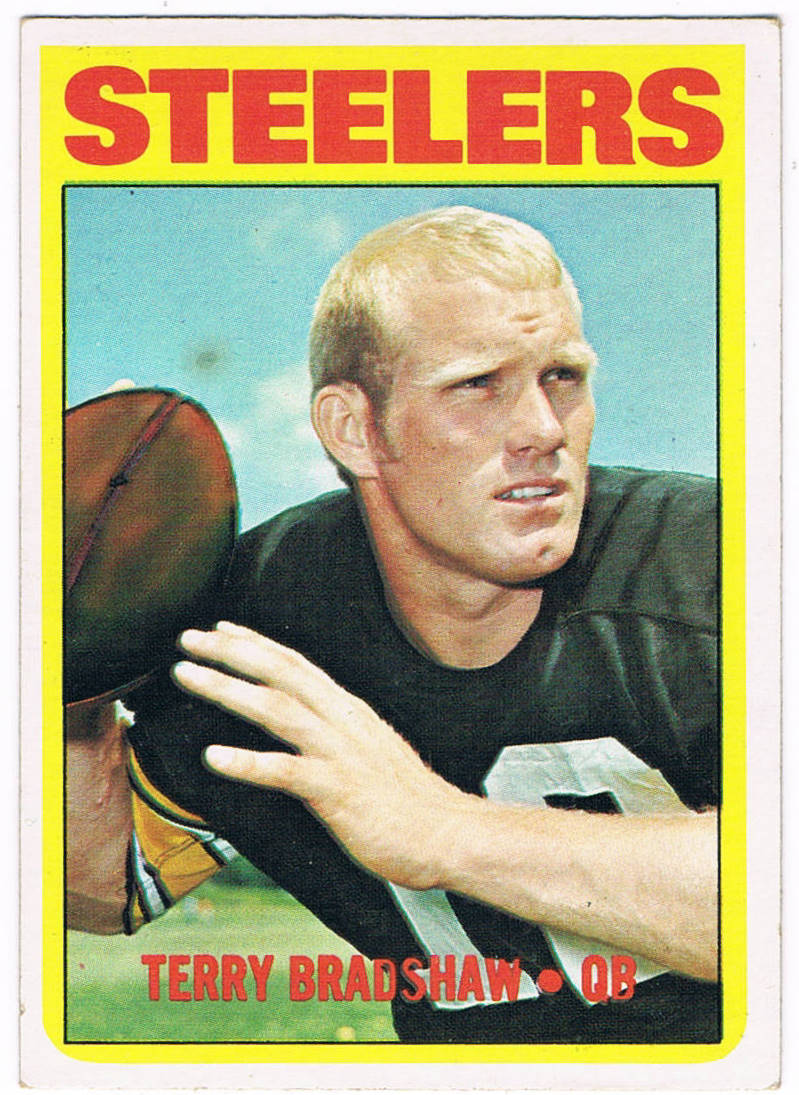
In 1972, there was a subset of "Pro Action" cards and an increased commitment by Topps to show "game day" pictures...and they really stand out by how awful they are. And in the high-number set, here's one of the two Steelers:


It's Andy Russell again, but the helmet in his hands has an ominous shadow right where the logo should be. And he seems to be inadvertently giving "the finger" to Topps as an expression of disapproval.

There was one other thing that needed to be removed from some of the cards...


Take a closer look at the football in Terry Bradshaw's hand:


It's been airbrushed as well, in order to get the NFL logo off of the pigskin.

It would take until 1982 before the logos returned to Topps cards. It was a really long decade for football card collectors.

Friday, September 16, 2011

A Shameless Plug

One of the links I have listed off to the side of this blog is Cardboard Connection. I don't generally recommend specific sellers on this blog, but this one is an exception because I'm helping out behind the scenes there.

No, I'm not selling. The site's owner Mike has asked me to help him with descriptions of vintage sportscard sets (all sports, not just baseball) and I'm working on getting them done in a somewhat timely manner. Many of them are now listed on this page, and I provided the info on most of the pre-1980 sets listed. What i think is really neat about some of the sets is the way there are links to eBay auctions. That's not always helpful -- the first several auctions for Obaks on this page are actually for modern cards using the same name -- they are helpful in tracking down material from certain sets.

I actually got that gig simply because Mike looked online and saw what I've put online about cards, both with this blog and with my Vintage Baseball Cards site. There will be more to come, but feel free to check out his site now and see what is there.

And if you end up doing business with Mike, let him know I sent you there.